

In short: The Gap Selling Deal Wheel™ is A Sales Growth Company’s replacement for traditional CRM sales stages. A stage tells you what the seller did and where a deal sits. The Deal Wheel tells you what the buyer actually said. It is a 13-slice wheel, and every slice is scored red, yellow, or green on one input only: Buyer Input Data (BID), the buyer’s own words. Stages read across. The Wheel reads down, into the depth of each answer. A full wheel is not a strong deal. A green wheel is.
Sales stages tell you how busy your reps are. They do not tell you if there is a deal.
Open your CRM and look at what a stage actually measures. Discovery call held. Demo done. Proposal out. In negotiation. Every one of those is something the seller did. Not one of them tells you a single thing the buyer told you.
So a rep can walk a deal from stage two to stage five without learning anything new about the buyer’s problem. You have heard it in every pipeline review. “We’re in stage three, great demo, proposal goes out Friday.” Fine. What is the problem? What is it costing them? Who signs? And the room goes quiet.
Then we wonder why the forecast is a guess. Gartner found that only 45% of sales leaders and sellers have high confidence in their own forecast, and its analysts noted that buyers “simply don’t follow a linear progression of steps” to reach a decision. Buyers do not buy in stages. We invented stages so we could track ourselves.
A stage is flat. A deal has depth.
A stage sits on one line. Stage 2, stage 3, stage 4. It tells you where a deal is, not how strong the information behind it is. “Budget confirmed” looks exactly the same whether the CFO said “we’ve set aside $400K to fix this by Q2” or “we’ve got money for the right thing.” Those are not the same deal. The stage cannot tell them apart.
Everything a buyer tells you has depth. It is strong, weak, or somewhere in between. That is what red, yellow, and green measure, and they measure down rather than across. Every color comes from what the buyer said. Not what the rep thinks. Not what box got checked. The buyer’s words.
Flat hides things. A buyer gives you their decision criteria on the first call. In most stage setups, that information sits and waits its turn. On the Wheel it shows up that day and changes what the rep does next.
What the Gap Selling Deal Wheel measures
The Wheel has thirteen slices. Each slice is a piece of information the buyer has to give you. Each one is scored green, yellow, or red based only on the buyer’s words. You see what is missing in a single look, and the order the buyer says it in does not matter.
| # | Slice |
|---|---|
| 1 | Physical and literal |
| 2 | Problem |
| 3 | Impact |
| 4 | Root cause |
| 5 | Future state |
| 6 | Intrinsic motivation |
| 7 | Size of the gap |
| 8 | Cost of inaction |
| 9 | Competitors identified |
| 10 | Budget vs affordability |
| 11 | Buying process |
| 12 | Decision criteria |
| 13 | Next yes |
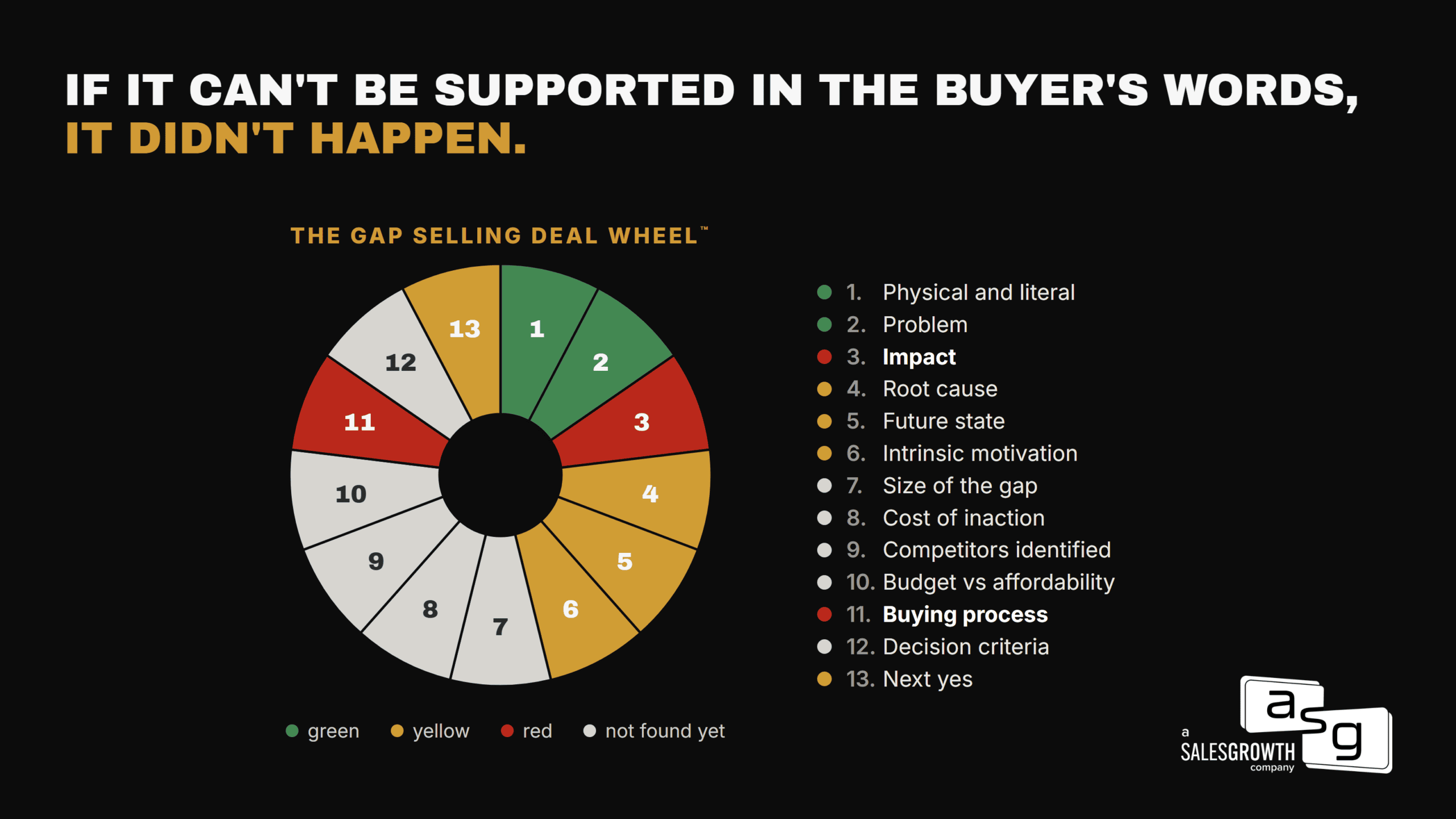
Buyer Input Data: if it cannot be supported in the buyer’s words, it did not happen
For decades the whole system ran on the rep’s read. The rep owned the buyer conversation and decided what the buyer’s “yes” meant. If you wanted to know what the buyer said, you asked the rep. Pipeline reviews were spent interpreting that read, and forecasts were built to discount the hopium.
That is over. Calls are recorded. Emails and texts are written down. Everything the buyer says can be captured, attached to the opportunity, and treated as the record. At ASG we call it BID, Buyer Input Data. The rule is simple: if it cannot be supported in the buyer’s words, it did not happen.
Think about what that does to a pipeline review:
- “They loved the demo.” Show me where the buyer said what it is worth to them, and how much.
- “The CFO’s on board.” Did the CFO say that, or did your champion?
- “Budget won’t be an issue.” Who exactly said that?
- “They said this looks great.” Did they tell you what “great” means and why?
What about the dinner, the hallway, the call from the car? Send the recap. When the buyer replies, now it is their words. A text on your personal phone becomes a screenshot in the record. And if something that was not captured contradicts what was, it does not count.
Full is not green. Strong is green.
One of the sharpest objections we heard was this: “You can fill the pie and still lose.” Correct. A wheel full of red is a deal you know everything about and should not be working. A fully checked stage three cannot tell you that. It only tells you the rep did the activities.
Red, yellow, and green only work if you write down what each color means, in the buyer’s words, before you score a single deal. Green on cost is not the buyer saying “yeah, it’s a big problem.” It is the buyer putting a number on it and saying it is worth fixing. Red is the buyer telling you another year of this will not hurt much. Skip that step and the colors become a checkbox with three options. Do it, and the color cannot be faked, because the buyer’s own words sit right next to it.
What the Wheel changes
When every answer is in front of you, scored on what the buyer said, the whole operating rhythm changes:
- The forecast is built on what buyers said, not on where a deal sits or what the rep did last week.
- Deal reviews become a conversation about the buyer’s problem. You read what the buyer said instead of hearing the rep tell the story again.
- Managers coach the weak slices instead of the deals that are already late.
- Leaders see which answers each team keeps coming back from the buyer without.
- The org learns. Tag every deal by the problem the buyer is solving, and in a couple of quarters you know which problems close, which close big, and which ones go cold every time. Stages never knew what the problem was.
- Win rates go up, because reps stop working deals the Wheel already told them were red.
This changes the AE’s job
Solution selling, consultative selling, SPIN, all of it was pointed in the right direction and kept failing, because nobody could see what the buyer actually said. The rep was the arbiter of the data.
Now the AE is an information gatherer. The best reps will be the ones who are best at getting the buyer to open up and work through the problem with them. The only way to get more information is to build more trust. Put AI on the Wheel and it tells the rep which slice is weak and what to go get next.
Try it this week
Pick your biggest deal. Without asking the rep, find what the buyer actually said about what doing nothing costs them. Their words. Strong, weak, or you do not know? If you do not know, your stages were never telling you.
Then go wider. Pull your top twenty deals and ignore the stage. For each one, write down what you know from the buyer about the problem, the impact, and the cost of doing nothing. Score each slice. Watch how many of your “late stage” deals come out red.
Stages tell you how busy your reps are. BID tells you if there is a deal. Which one is your forecast built on?
Frequently asked questions
What is the Gap Selling Deal Wheel?
The Gap Selling Deal Wheel™ is A Sales Growth Company’s framework for replacing traditional CRM sales stages. It is a 13-slice wheel that scores a deal on what the buyer has actually told you, with each slice marked red, yellow, or green based on the strength of the buyer’s own words rather than seller activity.
How is the Deal Wheel different from sales stages?
A sales stage measures what the seller did and where a deal sits in a linear pipeline. It reads across. The Deal Wheel measures the depth and strength of what the buyer said, slice by slice. It reads down. A deal can move across every stage without the buyer giving you anything new. A slice only turns green when the buyer gives you something.
What is Buyer Input Data (BID)?
BID, Buyer Input Data, is the only data the Deal Wheel scores on: what the buyer actually said, captured from recorded calls, emails, texts, and written recaps. The governing rule is that if a claim cannot be supported in the buyer’s own words, it did not happen and does not count toward the deal.
What are the thirteen slices of the Deal Wheel?
Physical and literal, Problem, Impact, Root cause, Future state, Intrinsic motivation, Size of the gap, Cost of inaction, Competitors identified, Budget vs affordability, Buying process, Decision criteria, and Next yes. Each is scored green, yellow, or red on the buyer’s words.
Does a full wheel mean a strong deal?
No. A wheel full of red is a deal you know everything about and should not be working. Full is not green. Strong is green. The colors only mean something if you define what red, yellow, and green stand for, in the buyer’s words, before scoring any deal.
Want to put the Gap Selling Deal Wheel™ to work in your pipeline? Talk to A Sales Growth Company.

0 Comments