

A cold call starts with the rep doing all the talking. A discovery call starts with a buyer already willing to answer questions. Those are two different conversations, built on two different starting conditions, and training reps to run both the same way is what produces low connect rates that get mistaken for a confidence problem.
Gap Prospecting is the name for the first conversation: reaching a buyer who has not asked for contact, does not know who the rep is, and has given no signal of interest. That conversation runs in one direction until something the rep says makes the buyer curious enough to ask a question back. The moment that happens, the buyer has started doing the thing discovery depends on, which is talking.
Gap Prospecting is a one-way conversation that a rep converts into a two-way conversation by creating curiosity about a problem the buyer has not yet connected to anything, while Gap Selling discovery is a two-way question and answer process that starts once that curiosity already exists and maps a buyer’s current state against a defined future state. The distinction decides which questions are usable at a given moment: a rep running discovery questions on a buyer who has not started talking yet is using a good question at the wrong point in the conversation.
What Gap Prospecting Means
Prospecting, in this sense, is the act of reaching out to someone who does not know who the rep is, does not care, and is not thinking about the rep’s product or service. Nothing about the contact has been invited. The buyer has not read a case study, requested a demo, or signaled any interest a rep could point to.
Because nothing has been invited, the conversation only moves in one direction, from rep to buyer, until the buyer’s own curiosity takes over. Curiosity is what gets a buyer to read past the first line of an email, finish a voicemail, or stay on a call past the opening seconds. The specific signal that a conversation has flipped from one-way to two-way is a question. A buyer who asks something back has started supplying information instead of only absorbing it, which is the actual goal of the entire interaction.
Gap Prospecting Compared to Gap Selling Discovery
Gap Prospecting shares its problem-centric premise with Gap Selling: neither one opens with the product. Where the two separate is in what condition the buyer is already in when the conversation starts.
| Dimension | Gap Prospecting | Gap Selling Discovery |
|---|---|---|
| Conversation structure | One-way until curiosity flips it | Two-way question and answer from the start |
| Buyer’s starting state | No prior signal of interest | Some self-identified interest already shown |
| Rep’s first job | Prove they are not a threat and earn a few seconds of attention | Map the buyer’s current state against a defined future state |
| What moves the conversation forward | Curiosity about a problem the buyer has not connected to anything yet | Specific questions that surface root cause and cost of inaction |
| Signal of success | The buyer asks a question back or agrees to a next step | The buyer produces information a rep can act on |
Gap Selling discovery usually starts downstream of some signal the buyer has already given: a search, a demo request, or a reply to a message that connected with something the buyer was already considering. Even a small amount of self-identified interest is enough for a two-way exchange to begin right away, because the buyer has implicitly agreed to answer questions. Gap Prospecting starts with no such head start. The buyer has not agreed to anything yet, which is why the first job is not asking questions at all.
The Two Jobs of a Gap Prospector
Before any question gets asked, a gap prospector has exactly two jobs. The first is convincing the buyer they are not a danger, enough that the buyer stays on the phone or keeps reading long enough to answer something. The second is cutting through the surrounding noise to get the buyer to act, which in practice means agreeing to a next step like a meeting.
Both jobs get solved the same way: by leading with a problem instead of a product. A door-to-door pitch about tree-trimming services gets a door closed within seconds, because the homeowner has no reason to care yet. The same homeowner, told that a fungal infection is spreading through the county, that it kills trees and spreads to other vegetation, and asked whether anyone has checked their own trees for it, keeps listening and starts asking questions. The homeowner at the door stayed the same person. The message connected to a specific, recognizable problem instead of a product category, and that connection is what kept the conversation going.
Why the Distinction Changes How Prospecting Gets Coached
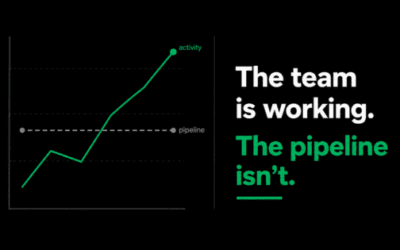
A rep opening a cold call with a discovery-style question like “how are things going with your current vendor” is asking a two-way question of someone who has not agreed to a two-way conversation yet. The buyer has little reason to answer honestly, or at all, because nothing in the opening earned that level of engagement. The opening seconds of a cold call need content built to create curiosity, since the buyer has not yet agreed to supply information. Coaching reps on that skill separately from discovery questioning, instead of reviewing every hang-up the same way, is what actually closes the gap between a rep’s activity numbers and their results.
This structural separation between prospecting and discovery, worked out in full in Gap Prospecting, is also why a strong closer can still run a weak cold-calling program. Closing and opening draw on different instincts, and a rep who has never been taught to separate them keeps applying the wrong one at the wrong moment.
Separating the two skills in coaching, rather than reviewing every rejected call the same way, is itself a trainable habit built through repeated, structured practice.
Frequently Asked Questions
What is Gap Prospecting?
Gap Prospecting is a one-way conversation with a buyer who has not asked for contact and has no reason yet to care, which only becomes a two-way conversation once something the rep says sparks enough curiosity for the buyer to ask a question back. It describes the stage that happens before discovery, aimed at buyers who have given no signal of interest.
How is Gap Prospecting different from Gap Selling discovery?
Gap Selling discovery is a two-way question and answer process that starts once a buyer has already shown some interest, used to map the gap between a buyer’s current state and a defined future state. Gap Prospecting starts earlier, with a buyer who has not agreed to answer anything yet, and its job is converting a one-way message into the kind of two-way exchange Gap Selling discovery depends on.
What are the two jobs of a gap prospector?
The first job is convincing the buyer the rep is not a threat, enough that the buyer stays on the phone or keeps reading past the opening seconds. The second job is cutting through the volume of other outreach the buyer receives to get a specific action, usually agreement to a meeting. Both jobs are solved by leading with a problem the buyer recognizes rather than a description of a product.
Why does a one-way cold call become two-way?
A one-way conversation flips to two-way the moment the buyer asks a question back, because asking a question means the buyer has started supplying information instead of only receiving it. Curiosity about an unconsidered problem produces that question; a generic pitch about a product rarely does.
Should prospecting and discovery be coached as the same skill?
No. Cold outreach requires content built to create curiosity in a buyer who has not agreed to talk, while discovery requires content built to gather information from a buyer who already has. Coaching them identically produces reps who open cold calls with discovery-style questions a buyer has no reason to answer honestly.
Does Gap Prospecting apply when a lead comes from marketing instead of cold outreach?
Gap Prospecting describes outreach to a buyer with no prior signal of interest, so a marketing-sourced lead who has already engaged with content or requested information has effectively skipped the one-way stage. That lead can move straight into Gap Selling-style discovery, because the buyer has already supplied the small amount of interest Gap Prospecting exists to create from nothing.


0 Comments