
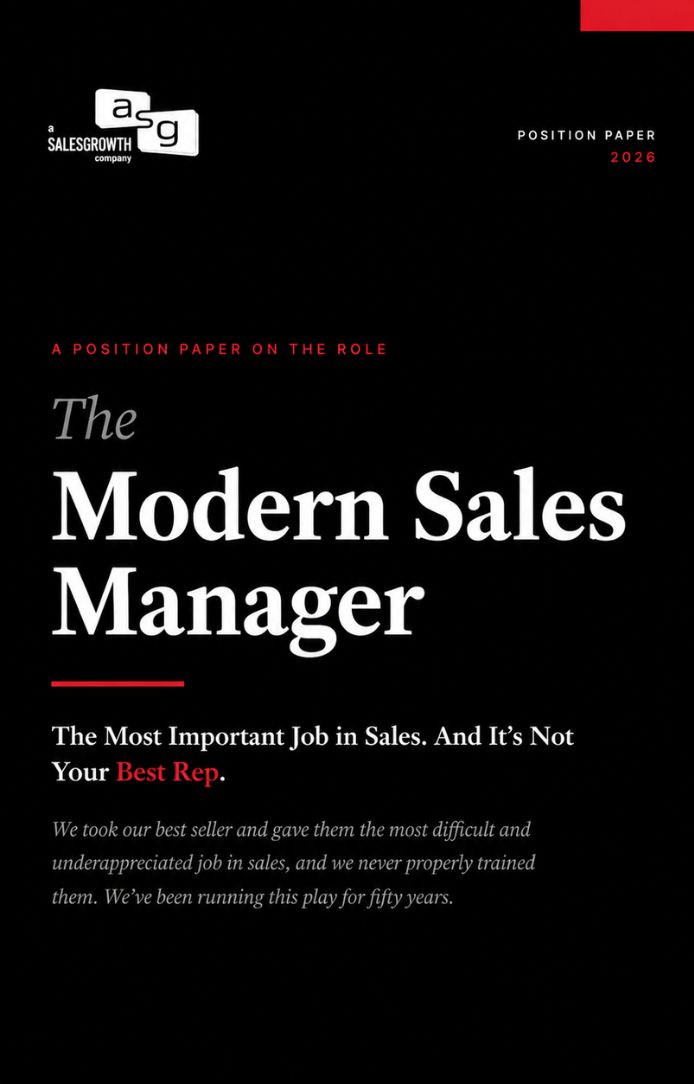
The Modern Sales Manager
Who you put in charge of your sales reps, and how they manage, decides whether the team hits its number. A study of 38,843 salespeople across 214 companies found that the better someone sold, the worse they managed a team. Teams with a manager who coaches consistently hit 91.2% of quota. Teams with a manager who only reacts once something's already gone wrong hit 84.7%, a 6.5-point gap running the exact same method in the same market.
There's one change that moves a sales team from averaging 84% of quota to consistently beating 91%. It comes down to a single habit: a manager who coaches every week instead of one who only steps in once a deal is already falling apart. For fifty years, companies have tried to close that gap by promoting their best rep into the manager role. A study of 38,843 salespeople across 214 companies found the opposite of what that fix assumes. The better a rep sold, the worse they tended to manage a team.
Everything a company spends on its reps depends on one person: the manager. When a rep goes through training, the manager decides whether it sticks. If the manager follows up and checks their work afterward, the rep keeps using what they learned. If the manager does not follow up, the rep goes back to old habits within a month. Coaching works the same way. A manager has to watch or listen to a rep's actual sales calls to know what happened on them. A stage change in the CRM does not give the manager enough information to help the rep improve. The forecast depends on the manager too. Someone has to look at a specific deal and decide if it will close. If the manager will not make that call, the forecast is just a guess. Remove that person from the team, or put someone weak in the job, and none of this happens.
Get this wrong and a company loses twice. It loses the salesperson who was closing deals, because that person is no longer selling. It also ends up with a manager who struggles to lead the team, and the best people on that team start leaving because of it. This happens three or four times a year at a typical company, and most leaders never add up what it costs them.
The best salesperson is often the wrong person to lead the team. Training, tools, and coaching only help a sales team if the manager knows how to make all of it stick. The real decision behind the gap between 91% and 84% is who gets promoted into the manager job, and whether that person can teach other people to sell instead of just closing deals alone.
Download the Paper
The forecast is clean. The deals get saved. The activity is up and to the right. That's exactly what the manager was asked for. We built a reporting-and-rescue job and called it management. This paper lays out the coaching system managers were never actually given.
What's Inside
Nine sections building one argument: the manager is the linchpin of the whole revenue org, the job we've handed them isn't the job that matters, and coaching it back to the job that matters is a system, not a personality.
The Fifty-Year Mistake
We take the best rep on the team and hand them a job that requires the opposite skill set. A study of 38,843 salespeople across 214 companies found that the sellers who got promoted the most turned out to be the worst managers, and the pattern held whether or not the company meant to run it that way.
The Linchpin
The frontline manager isn't a layer on the org chart. Every dollar spent on training, tools, and forecast discipline runs through whether that one person makes it real, and today the role carries more reps, more tools, and more admin than it did a decade ago, with none of the extra support.
The One Job
Strip away the roll-ups and the rescues and the frontline manager has exactly one job: the continual and sophisticated development of their reps. Do that well and the forecast, the pipeline, and the number all become a byproduct instead of a fight.
Coaching Is a System, Not a Personality
Some managers seem to have a natural gift for coaching. Benjamin Bloom's 1984 research says the gift is a method: the same one-on-one approach that pushed the average tutored student ahead of 98 percent of a normal classroom works for any manager willing to run it on purpose.
You Can't Develop What You Can't See
Most managers coach off the rep's version of what happened on the call. The paper makes the case for watching the tape directly, because a diagnosis built on secondhand information points the rep in the wrong direction as often as the right one.
Observe, Describe, Prescribe
The three-step loop that turns watching a call into actual development: see the exact moment the deal turned, describe it without judgment, and only then prescribe the fix, ideally after the rep names it themselves.
Run the Team Like a Portfolio
Every rep needs a different kind of attention: heavy coaching density for the new hire, harder and less frequent conversations for the veteran, and the most overlooked opportunity, the solid rep in the middle who's two or three fixes from a different level.
The Coaching Cadence
Sales execution gets coached in the flow of the work, in deal reviews and same-day notes on a call recording. Business acumen and career growth need a separate, slower rhythm. Managers who blur the two end up coaching whatever caught fire that week instead of the whole rep.
What the Org Has to Change
None of this survives an org that hands someone a team and no support. The paper closes with what leadership owes the manager in return: real training for the actual job, a second-line manager who coaches the coach, protected time on the calendar, and a promotion bar built on who develops people, not who closes the most deals.

Who This Is For
This paper is for revenue leaders who keep promoting their best rep into management and want to know why the team doesn't lift after the plaque goes up.
- CROs and VPs of Sales who decide who gets promoted into management, and want to know why the current bar keeps producing the same problem
- Frontline and second-line sales managers who inherited the title without the training, and want the actual mechanics of coaching instead of another leadership deck
- RevOps and Sales Enablement leaders who've shipped methodology training that didn't stick because no one coached it into the field after the rep walked back to their desk
- CEOs and board members who want to know why sales spending keeps climbing while the manager holding it all together gets none of the investment
FAQ
What is the "linchpin" in sales management?
A linchpin is a small, cheap piece of hardware that keeps a wheel from sliding off an axle. In a revenue org, the frontline sales manager plays the same role: not the most expensive part of the org, not the one anyone's watching, but the part everything else, training, deal reviews, and the forecast, depends on to hold together.
Should you promote your best salesperson to sales manager?
Not automatically. A study of 38,843 salespeople across 214 companies (Benson, Li, and Shue, "Promotions and the Peter Principle," Quarterly Journal of Economics) found that sales performance was negatively correlated with managerial performance: the better someone sold, the worse they tended to manage a team. Selling rewards what one person does alone. Managing rewards what other people do instead. The better test for a promotion is whether the person can develop other sellers, not how much they sold themselves.
Why do the best salespeople make the worst managers?
Economists Alan Benson, Danielle Li, and Kelly Shue studied 38,843 salespeople across 214 companies and more than 1,500 promotions into management (Quarterly Journal of Economics, "Promotions and the Peter Principle"). Sales performance was negatively correlated with managerial performance: the better someone sold, the worse they tended to do running a team, because selling rewards what one person does alone and managing rewards what other people do instead.
Where do the 91.2%, 84.7%, and four-to-one figures come from?
CSO Insights found dynamic-coaching teams hit 91.2% quota attainment versus 84.7% for teams running chaotic, reactive coaching. ATD tracked 800 sales-training projects and found reps whose managers reinforce training close at roughly four times the rate of reps who get no reinforcement. Both figures describe the same pattern from different angles: coaching that actually happens changes what the rep does, and what the rep does shows up in the quota number.
How much does a sales manager affect team performance?
More than most org charts suggest. Gallup's engagement research, based on 183,000 teams studied over three decades, found the manager alone accounts for roughly 70% of the variance in how engaged a team is. In sales specifically, CSO Insights found teams with a disciplined coaching cadence hit 91.2% of quota, compared to 84.7% for teams that only coach reactively, a 6.5-point gap tied directly to how the manager runs the role, not the method or the market.
What is the observe, describe, prescribe coaching loop?
A three-step coaching mechanism. Observe means watching the actual call for the specific moment a deal turned. Describe means telling the rep what happened, plainly, with no judgment attached. Prescribe comes last, on purpose, ideally after asking the rep what they'd do differently, because a rep who talks their way to the fix keeps it.
What does "coaching the team like a portfolio" mean?
Treating each rep as a different investment instead of giving everyone the same one-on-one. New reps get the heaviest attention because coaching density early speeds up the ramp. Veterans get less time but harder conversations. The solid rep in the middle gets the most leverage, because they're usually two or three specific fixes from a different level.
How is sales execution coaching different from career development coaching?
Sales execution, discovery, objection handling, deal strategy, gets coached in the flow of the work: deal reviews, pipeline reviews, same-day notes on a call recording. Business acumen, communication, and career growth need a slower, separate rhythm, a monthly or biweekly conversation that has nothing to do with the deal in front of the rep.
Where do the 38,843 and 98 percent figures come from?
The 38,843 figure is Benson, Li, and Shue's "Promotions and the Peter Principle" (Quarterly Journal of Economics). The 98 percent figure is Benjamin Bloom's 1984 "2 Sigma" research (Educational Researcher): the average student tutored one-on-one outperformed 98 percent of students in a conventional classroom.
How many companies train their sales managers?
Not many. A 2025 survey by SBI and the Revenue Enablement Society (n=134) found that roughly 40% of companies have no dedicated training program for sales managers at all, and only about a third had trained their managers in the prior year. Most sales managers are promoted into the role and never formally taught how to run a deal review, coach a call, or hold a forecast.
Is this specific to Gap Selling, or does it apply to any sales methodology?
The coaching system applies regardless of which method a sales org runs. What changes is whether the manager has a real system to coach against: deal criteria, forecast discipline, a defined method. A manager can only run a system the org has built.
Who should read this paper?
CROs and VPs of Sales who keep promoting their best rep into management, current frontline and second-line managers, RevOps and sales enablement leaders, and CEOs or board members who want to know why sales spending keeps climbing while the manager holding the team together gets none of the investment.
About A Sales Growth Company
A Sales Growth Company builds sales training and consulting programs on Gap Selling and the Problem-Centric™ Operating System, the methodology family built to connect find, close, and keep into one system instead of three disconnected jobs.
The firm has worked with B2B sales organizations for 25 years across hundreds of companies. The coaching gaps named in this paper are the same patterns ASG has spent 25 years helping revenue organizations find and fix. ASG is named a Representative Vendor in the 2025 Gartner Market Guide for Sales Training Service Providers.
Download the Paper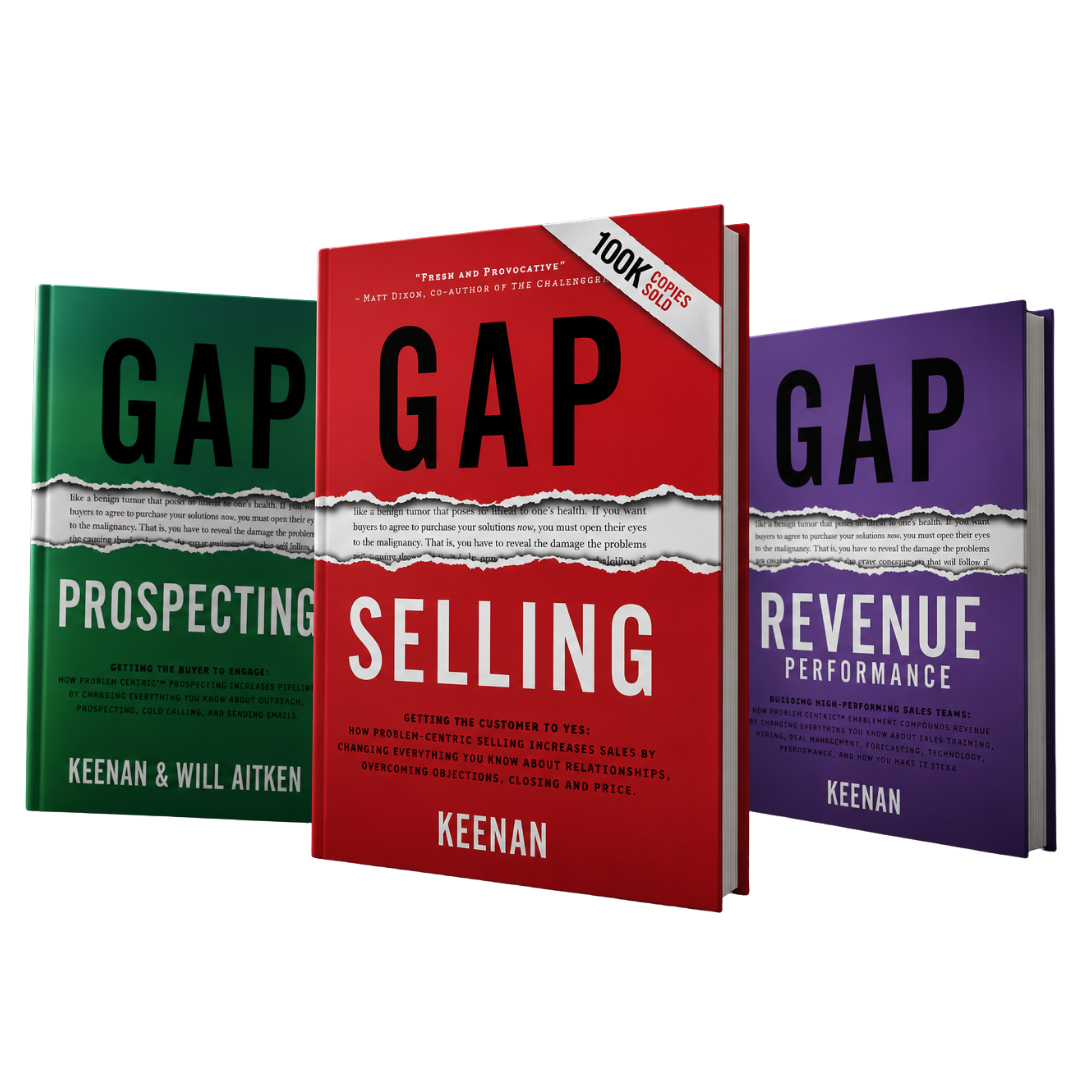
Talk to Us
Want to know whether your managers are coaching or rescuing? We'll show you the gap between what they're doing today and what the role actually requires, before you promote the next best rep into it.
Let's Talk