
The Modern CRO: Why the Role Keeps Failing — and What It Has to Become
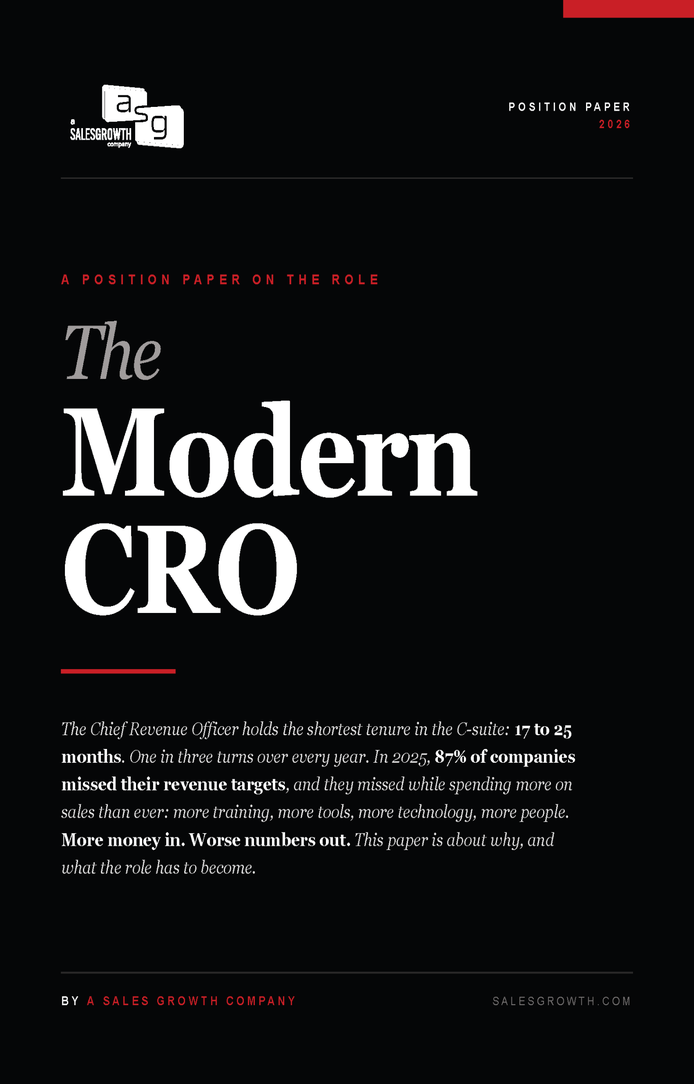
CRO tenure averages 17 to 25 months. One in three turns over every year. In 2025, 87% of companies missed their revenue targets while spending more on sales than ever. This paper is about why, and what the role has to become.
The Chief Revenue Officer holds the shortest tenure in the C-suite — 17 to 25 months, against four to seven years for the CFO and the CIO. One in three is replaced every year. In 2025, 87% of companies missed their revenue targets while pouring record investment into the revenue function. CRM spend grew nearly sixfold in a decade. Enablement platform spend grew almost fivefold. The training market runs tens of billions a year. The investment went up. The results went down.
When misses happen at that scale, across that many companies, the problem is not who is in the chair. It is how the role is understood — by the CRO, by the CEO, by the board, and by the investors who set the target and start the clock.
The number is a lagging measure. No one in the seat can produce it directly, because the CRO does not carry a bag or make the sale. Hitting the number requires pulling the right levers — the handful of behaviors and system changes that produce it — and most CROs never build the ability to identify those levers or execute against them. When they miss, the response is a set of reflexive initiatives: new tools, new headcount, a new methodology, a new comp plan. Almost never a diagnostic of the system causing the problem. The miss continues, the clock runs out, and the next leader inherits the same engine with less runway.
This paper redefines the role. The number stays — every CRO is still hired to hit it. What changes is how the Modern CRO understands the mandate. The number is the goal. Building and running the system that produces it, repeatedly and predictably, is the job.
Download the Paper
In 2025, 87% of companies missed their revenue targets while spending more on sales than ever. The problem is not who is in the chair. It is how the role is defined — and what happens when you hand someone a number they cannot produce directly and evaluate them on whether they hit it.
What’s Inside
Nine sections building a single argument: the CRO role is structurally broken, and here is exactly what it has to become.
It's the Mandate
CRO tenure averages 17 to 25 months against four to seven years for the CFO and CIO. One in three is replaced every year. In 2025, 87% of companies missed revenue targets while CRM spend grew nearly sixfold in a decade and enablement platform spend grew almost fivefold. The investment went up. The results went down. The problem is not the spend and it is not the people — it is how boards, CEOs, PE firms, and VC firms understand what the role is for and what they hold the leader to once they are in the seat.
The Number Is the Goal. Execution Is the Job.
The number is a lagging measure — a result that arrives after the work is done. No one can act on a result directly. The only thing anyone can move is the behaviors that produce the result, and the system that produces the behaviors. The old CRO directs energy at the result, which is the one thing no one can move. The Modern CRO directs it at the engine underneath, which is the only thing anyone can. That distinction is the line between a reactor and a systems thinker.
Why the Old Role Fails
The loop runs the same way almost every time. A target is set off the financial plan with no real read on what the revenue engine can deliver. The CRO inherits it, leans on pressure, rolls out a new tool or cadence, throws themselves into the biggest deals. None of it touches the engine. The engine does not change. They miss the number. The board replaces them — faster and cheaper than confronting the target or the system. The next leader tears out what was there and installs what they used before, not because they assessed it and found it lacking, but because they cannot assess it. It is constant demolition with no architect.
The Five Revenue Leaders, and Why Four Don't Repeat
There are five ways a revenue leader produces a number. The Beneficiary inherits a working engine and runs it. The Surfer rides a rising market. The Hero forces the number through brute force and personal heroics. The Lucky rides timing and a handful of large accounts. The Builder builds the system that produces the number on purpose and can do it again. From the outside, all five look identical. One diagnostic question separates the Builder from the other four — and the answer reveals which type is in the seat.
How the Modern CRO Sees Revenue
The reactor sees the number. The systems thinker sees the chain underneath it. A lagging measure is a result no one can act on directly — win rate, forecast accuracy, percent at quota. A leading measure is a behavior that moves the lag — discovery quality, manager coaching cadence, pipeline quality, ramp-milestone attainment. A system component is not the same as a part. The hiring profile, the methodology, and the comp plan are parts. A component is a part plus the tools, processes, and feedback loops that connect it to the others. Most organizations have all the parts and no system because nothing links them. A methodology with no deal-inspection process to enforce it, no instrumentation to see it, and no feedback loop to correct it is a part on a shelf.
The Ability That Defines the Role
One ability separates the Builder from every other revenue leader: the ability to look at the revenue engine and say whether it can hit the goal, why it cannot, and what it would take to close the gap — with real numbers behind every claim. On their own engine they answer on the spot because they built it and know what it can deliver. On a new engine they tell you what they would need to assess and come back with a credible answer built on engine analysis, not effort or optimism. That ability makes the Modern CRO the company's authority on what revenue is possible — and the gate on every growth commitment the company makes.
The New Operating Model
Seven observable responsibilities define the Modern CRO's role. Six are the work: own the causal model of revenue, diagnose at the cause layer to the breakdown point, instrument the system with one source of truth, run a portfolio of leaders by system weakness rather than deal size, build for the compounding curve and protect those investments under pressure, own the performance system end to end. The seventh is what keeps the leader in the seat long enough to do the other six: lead up, not just down — reconcile the target to the engine's real capability before the number is locked, and hold firm under pressure to trade the curve for the quarter.
What Each Stakeholder Has to Rethink
The redefinition changes what each stakeholder asks of the role. The CEO who has cycled through three revenue leaders in five years and watched the engine fail to improve each time. The board governing on a quarterly attainment binary that guarantees the 18-month spiral. The PE firm paying for the demolition cycle across a portfolio. Each one has a specific change to make in how they hire, how they set the target, how they grant runway, and what they hold the leader to.
The Payoff: From 18 Months to a Multi-Year Engine
Harvard Business Review found a 62% chance of flat or declining revenue in the year after a CRO change, with a median decline of roughly four percentage points. The 18-month CRO is not inevitable. Redefine the role, evaluate on the trajectory of system predictability rather than a quarterly binary, and protect the runway — and the spiral breaks. The seat stops rotating. The system the Modern CRO builds compounds instead of resetting to zero on every leadership change.

Who This Is For
This paper is written for the people on both sides of the CRO conversation — the leaders in the seat and the stakeholders who put them there.
- Chief Revenue Officers who feel the pressure of the mandate, suspect the role is structurally broken, and want a framework for understanding what the job requires and how to make the case for the runway to do it
- CEOs who have cycled through revenue leaders and are starting to question whether the problem is the people or the role definition
- Boards and investors who govern on quarterly attainment numbers and want to understand why that evaluation criterion produces the spiral they keep seeing
- PE firms running portfolio companies where revenue leadership turnover is destroying value faster than operating improvements can create it
- Heads of Sales and VPs of Revenue building toward a CRO seat who want to understand what the Modern CRO does differently from the leader who misses at month 18
FAQ
Why do CROs fail so often?
The CRO is handed a number they cannot produce directly and evaluated on whether they hit it. The number is a lagging measure — it arrives after the work is done, and no one can act on it directly. When the miss comes, the response is a set of reflexive initiatives: new tools, new headcount, a new methodology. Almost never a diagnostic of the system causing the problem. The engine does not change, the miss continues, and the board replaces the leader. The next leader tears out what was there and installs what they used before, not because they assessed it and found it lacking, but because they cannot assess it. The loop runs again. In 2025, 87% of companies missed their revenue targets while spending more on sales than at any point in history. The problem is not who is in the seat. It is how the role is defined and what the leader is evaluated against.
What is the average CRO tenure?
CRO tenure averages 17 to 25 months — the shortest in the C-suite by a significant margin — based on SaaStr's analysis of 14,000 executives in Pave's compensation database, with a consensus range across Harper Hewes, Scalewise, and Revenue Operations Alliance. The CFO and CIO average four to seven years in comparison. One in three CROs is replaced every year. Harvard Business Review found a 62% chance of flat or declining revenue in the year after a CRO change, with a median decline of roughly four percentage points, based on a study of 164 SaaS, IT, and services firms between $100M and $5B in revenue.
What is a revenue system and how is it different from having the right parts?
A revenue system passes five tests — and most organizations fail at least three. Connected: the output of each component is the input to the next, from hiring profile through ramp through methodology adoption through deal quality through forecast accuracy. Causal: you can name which input produces which output and the size of the lever. Instrumented: there is one trusted, trended source of truth with visibility into the behaviors that drive outcomes, not just the outcomes. Reinforced: a closed feedback loop keeps the behavior happening after it is taught — inspection at cadence, an active coaching loop, instrumentation that catches drift and feeds it back. Predictable and compounding: revenue gets more predictable over time and improvements stack quarter over quarter. Having the parts — a methodology, a CRM, an enablement team, a comp plan — is not the same as having a system. The wiring is what makes it run, and the wiring is invisible from the top.
What are the five types of revenue leaders?
The Beneficiary inherits a working engine and runs it — the system predates the leader and the trend line is flat. The Surfer rides a rising market — their growth line and the market's growth line are the same line. The Hero forces the number through brute force — discounts climb, margin falls, turnover is high, and results spike one quarter and crater the next. The Lucky rides timing and a handful of large accounts — revenue concentrates in a few accounts and quarters are lumpy. The Builder builds the system that produces the number on purpose and can do it again — predictability improves over time and the engine runs without the leader in every deal. From the outside all five look identical. The difference is on the inside, and one diagnostic question separates the Builder from the other four.
How do you identify a Builder versus the other four revenue leader types?
Ask anyone in the seat: "Can this engine hit the goal?" Then ask "Why?" Then ask "What will it take to close the gap?" The Builder answers honestly — yes or no — and the why is the causal chain with real numbers behind it. On their own engine they answer on the spot. On a new engine they tell you what they would need to assess and come back with a credible response built on engine analysis. The Beneficiary says the team is strong. The Surfer walks through everything they have done. The Hero talks about leadership, accountability, and execution discipline. The Lucky points to specific accounts and specific moments. None of them can name the causal chain with real numbers, because they never built the ability to read an engine. They rode conditions.
What is the difference between a lagging measure and a leading measure in sales?
A lagging measure is a result no one can act on directly — win rate, deal size, percent at quota, forecast accuracy, cycle time, bookings, net revenue retention. It arrives after the work is done. A leading measure is a behavior that moves the lag and that a team can change through training, inspection, and cadence — discovery quality, value quantification, manager coaching cadence, pipeline quality, ramp-milestone attainment, methodology adherence. The reactor sees a miss and reacts to the lagging measure with a new tool or a new hire. The Modern CRO traces the miss back through the leading measure to the broken or missing system component. That distinction is the line between managing symptoms and managing the system.
What are the three disciplines of the Modern CRO?
Assess, Build, and Execute — and they run in order. Assess: before building anything, confront reality. Can the engine produce this number given the market and the organization's capability? Run the five tests, find the breakdown points, and trace each weak lag back through its leading measure to the broken or missing component. Build: link people, strategy, and operations into a system that passes the five tests — wire the components so each feeds the next, document the causal chain, install the instrumentation, stand up the reinforcement loops. Execute: act on the leading measures on a recurring cadence — weekly at the team level and on a 13-week rhythm to the board. The Assess discipline is where the highest-leverage work sits. It is what turns the board conversation from hope into engineering.
What happens to revenue when a CRO is replaced?
Harvard Business Review found a 62% chance of flat or declining revenue in the year after a CRO change, with a median decline of roughly four percentage points, in a study of 164 SaaS, IT, and services firms between $100M and $5B in revenue. The value destruction goes deeper than the miss. Each new leader tears out what was there and installs what they used before — not because they assessed it and found it lacking, but because they cannot assess it. The organization churns through configuration after configuration, each one ripped out before anyone could tell whether it worked. A real system never gets built because building one takes longer than the seat lasts.
What does it cost to run a sales team beyond salary and commission?
Beyond salary and commission, companies spend $85,000 to $110,000 per quota-carrying rep annually — spread across sales technology, enablement platforms, training and L&D, sales operations, and related functions, distributed across multiple budgets so no single leader ever sees the total. That figure comes from a 2024 component build-up across NextMSC, the Bridge Group SaaS AE Report, G2, Gartner, ATD, and the Alexander Group. In 2025, 87% of companies missed their revenue targets while that investment was at record levels. The spend is not the problem. The problem is that the spend is going into parts, not a system.
How should a board evaluate a CRO differently?
A quarterly attainment binary is a lagging, noisy verdict. Governing on it guarantees the 18-month spiral — the board pulls the trigger, resets the engine to zero, and the churn destroys value. The alternative is governing on the trajectory of system predictability: forecast accuracy trended over four or more quarters, win rate trended, percent of reps at quota, ramp time, and the documented causal chain that links the leader's behaviors to those results. The current number is the snapshot. The trend is the diagnosis. World-class organizations consistently forecast within roughly 5% against a median B2B variance of 15 to 25%. That gap is buildable, and a system is what builds it.
What is the Modern CRO's role in target setting?
Before the target is locked, the Modern CRO puts the engine's real numbers on the table — what the system produces today, the gap to any proposed target, and what it would take to close it. That math goes to the board before the number is set. When the board sees what the engine can do and what it would cost to do more, it grants the runway rather than firing the leader at month 18. Without that reconciliation, companies keep setting numbers they cannot hit and replacing the people they hand them to. The Modern CRO's authority extends beyond the quarter for the same reason — the synergy promised in an acquisition, the ramp assumed for a new product, the target set for entering a new market are each a bet on what the revenue engine can produce. The Modern CRO is the only person in the room who can say whether it can.
About A Sales Growth Company
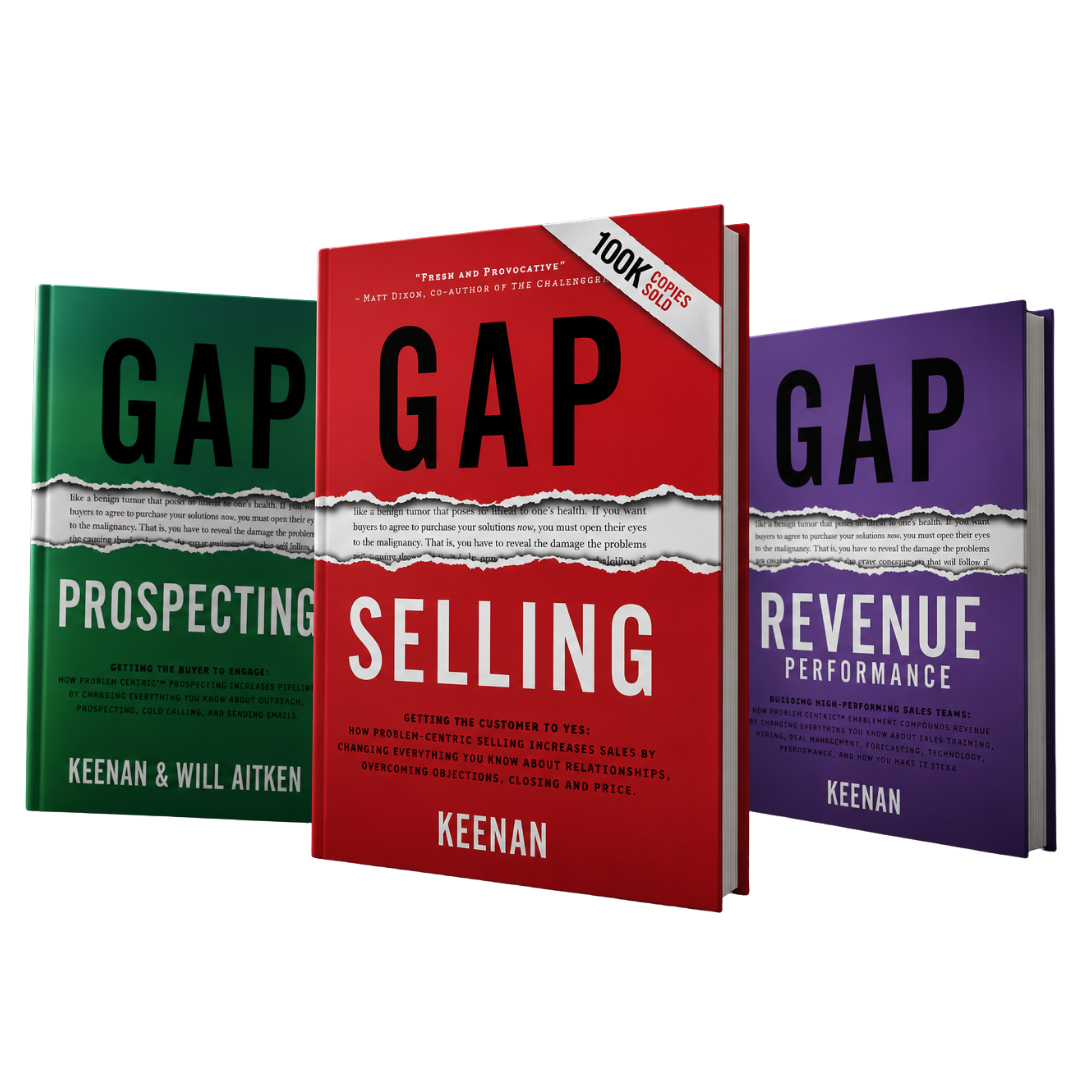
A Sales Growth Company is the creator of Problem-Centric® Selling and the architect of the Problem-Centric Operating System — the system that turns sales performance from a training problem into an operating discipline. The work connects the layers most companies run in isolation: the skills reps develop, the deals they work, the forecast their leaders commit to, the coaching that holds it together, and the way performance is measured and rewarded. The manager is the linchpin. The buyer’s problem sits at the center.
This paper was built from 25 years of consulting across hundreds of B2B sales organizations and from primary research cited in full in the appendix. A Sales Growth Company is a Representative Vendor in the 2025 Gartner Market Guide for Sales Training Service Providers.
Talk to Us
If you are in the CRO seat and want to think through what building the system looks like for your specific org — or if you are a CEO or investor trying to understand whether your revenue engine is real — reach out. Tell us where the engine is failing and what you have already tried.