
Gap Selling or Challenger Sale: Which Sales Methodology Fits Your Team?
What each one is built on, where each produces results, and how to make the right call for your team.
Sales leaders picking a methodology tend to make that decision based on two things: who used it at their last company, and which brand they recognize from a Gartner report or conference. Neither tells you whether the methodology will work for the team in front of you.
Gap Selling and Challenger Sale are built on different theories of why a buyer buys. Challenger was built from a 2011 CEB study that identified which behavioral profiles outperformed in complex deals — the methodology trains reps to replicate those behaviors. Gap Selling was built on the psychology of buyer change — buyers don’t move until their current situation becomes untenable, and the rep who diagnoses that situation with the most precision is the one who closes. Those two starting points produce different rep behaviors, different coaching models, different deal reviews, and different outcomes. Choosing the wrong one for your situation doesn’t just cost training budget — it installs the wrong behaviors into your team’s daily execution.
This guide covers what each is built on, where each produces results, what happens inside a team when either one gets rolled out, and how to make the right call for your specific situation.
Download the Guide
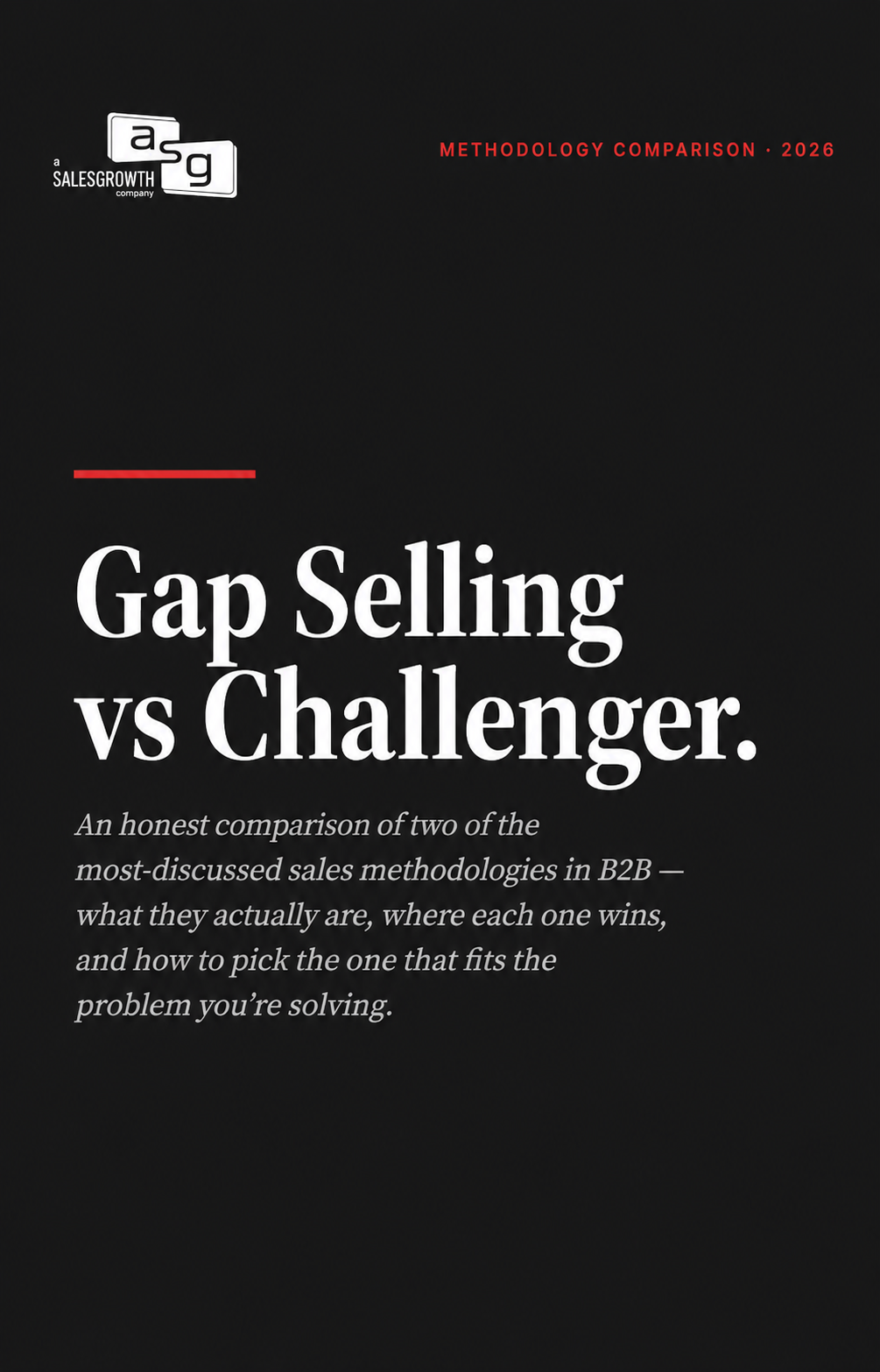
Challenger asks what the rep should do. Gap Selling asks why the buyer would ever change. One trains a behavior. The other names the condition that closes deals. This guide explains the difference and helps you pick the right one for your team.
What’s Inside
Ten sections covering what each methodology is built on, where each produces results, and how to make the right call for your team.
What Each One Is
Challenger was built from a 2011 CEB study of 6,000 reps that identified which behavioral profiles outperformed in complex deals, then built a training system to produce more of those profiles. Gap Selling was built on the behavioral science of how people decide to change — specifically, that buyers don't move until their current state becomes untenable. After reading this section you'll understand why two methodologies with similar reputations produce different results in the field.
The Decision Teams Never Name
When teams evaluate methodologies they compare features — what each one teaches, who's certified, what the training looks like. That comparison misses the actual decision: do you want to train reps to perform, or train reps to diagnose the buyer's problem? After reading this section you'll know which question your team needs to be answering.
Why These Methodologies Exist
Both were built in response to the same problem — relationship-and-pitch selling stopped producing results after 2008. From there they took different paths. After reading this section you'll understand the thesis underneath each approach and why the difference in starting point produces different outcomes in the field.
Side by Side
Both methodologies compared across eleven dimensions: core question, starting point, rep posture, discovery role, foundational artifacts, coaching model, buyer experience, organizational impact, ramp time, failure modes, and best fit. After reading this section you'll be able to evaluate both against what matters for your team.
Where Challenger Produces Results
Three specific conditions where Challenger earns its reputation and the reasoning behind each. After reading this section you'll know when Challenger is the right call — and why those conditions are rarer than they appear during the evaluation process.
Where Gap Selling Pulls Ahead
Three places Gap Selling produces outcomes Challenger doesn't, with the mechanism behind each. A rep who walks into a meeting with a pre-built commercial insight is working from a hypothesis. A rep who runs a structured diagnostic is working from the buyer's actual situation. After reading this section you'll understand why that difference shows up in close rates, forecast accuracy, and how fast new reps contribute.
What Happens to Your Team
Six things change depending on which methodology you choose: what buyers say after the meeting, what happens to the reps you've already built, what the forecast meeting looks like, what managers do with their time, how fast new hires ramp, and who is responsible for producing the content the methodology runs on. After reading this section you'll be able to trace the downstream effects of each choice through your org.
The Diagnostic Checklist
Each symptom your team is experiencing points to a specific methodology fit. Deals stalling without a clear reason, top reps who can't explain how they win, marketing producing decks reps don't use — after reading this section you'll have a clear signal for which problem you're solving.
The Trap Teams Fall Into
The wrong reasons drive most methodology decisions, and the result is a rollout that produces activity without changing outcomes. After reading this section you'll know the two traps to avoid and what the right basis for the decision looks like.
What Makes a Methodology Stick
Every methodology fades without an operating layer underneath it. Teams train, run a strong SKO, and within two quarters the language has drifted and reps are back to previous habits. After reading this section you'll understand what separates a training event from a system — and what has to be in place for new behaviors to survive into year two.

Who This Is For
This guide is written for revenue leaders evaluating a methodology decision — or who inherited one and need to understand whether it’s working.
- CROs and revenue leaders who need a clear basis for a training investment and want to understand what it will produce across a team
- VPs of Sales accountable for performance and forecast reliability who need to make the right methodology call
- Heads of Enablement designing programs that have to show up in deal execution, not just SKO completion rates
- Founders and CEOs involved in the sales motion who are deciding which approach fits the team and buyer they’re working with
FAQ
What is the core difference between Gap Selling and Challenger Sale?
Challenger trains rep behavior — specifically the behaviors observed in top-performing reps in the CEB study: teach the customer something new, tailor it to their world, take control of the conversation. The central artifact is the Commercial Insight, a researched perspective the rep delivers to reframe how the buyer sees their business. Gap Selling trains the diagnostic. Reps learn to identify the buyer's current state, define the future state they need to reach, quantify the gap between them, and surface the root cause keeping the buyer where they are. Challenger asks what the rep should do. Gap Selling asks what the buyer's problem actually is. That difference shows up in how deals get reviewed, how managers coach, how new reps ramp, and how reliably a team can forecast.
Which sales methodology works better for B2B?
It depends on the problem you're solving. Challenger works when your reps have deep industry expertise, when marketing can build and refresh a commercial insight at scale, and when your team has enough natural Challenger profiles to build around. Gap Selling works when you need a diagnostic that any rep can be trained to run — which describes the situation at the majority of B2B sales organizations. The guide includes a diagnostic checklist to help you assess your own situation rather than rely on a general answer.
Can you run Gap Selling and Challenger at the same time?
The concepts aren't mutually exclusive — a rep can deliver a strong commercial perspective and run a rigorous diagnostic. Running both as co-equal systems creates a different problem: reps and managers lose clarity on what the standard actually is. The guide covers what it looks like when teams try to layer them and what the more workable approach is.
How do I know if my team is suited for Challenger Sale?
Three conditions determine fit. Reps need enough industry expertise to deliver a commercial insight credibly — without that, the insight reads as a sales pitch. Marketing needs to be able to build and maintain that insight at scale across product lines, verticals, and buyer personas. And the Challenger behavioral profile needs to exist in enough of your team to build around — the CEB research put that at roughly 20% of a typical sales population. If those three conditions aren't in place, the methodology tends to collapse into a set of behaviors without the content to back them up.
Why do sales methodology rollouts fail?
The methodology is rarely the problem. What fails is the absence of an operating system underneath it. Reps finish the training, return to live deals, and the pressure of real opportunities pulls them back to whatever they were doing before. Without a structure that routes the methodology through deal reviews, manager coaching, and forecast conversations on an ongoing basis, the training loses its grip within a quarter. The guide covers what that operating layer looks like and why it's what most rollouts skip.
How long does it take to ramp a new rep on each methodology?
With Challenger, new reps typically need six to nine months before they can deliver a commercial insight credibly — the insight requires enough industry expertise that the buyer trusts it, and that takes time to develop. With Gap Selling, a new rep can run a meaningful diagnostic within weeks because the process is teachable regardless of tenure. The depth of impact quantification improves over time, but the diagnostic doesn't require deep expertise to activate.
About A Sales Growth Company
A Sales Growth Company builds sales training and consulting programs based on Gap Selling and the Problem Centric™ Operating System. The work focuses on helping revenue teams improve how they diagnose buyer problems, run deal reviews, and build the structure that makes a sales approach hold up past the training event.
This guide was built from 25 years of consulting across hundreds of B2B sales organizations. A Sales Growth Company is a Representative Vendor in the 2025 Gartner Market Guide for Sales Training Service Providers.
Talk to Us About Training
We can walk through how your team approaches training today, the issues limiting behavior change, and the conditions that shape execution in live opportunities.