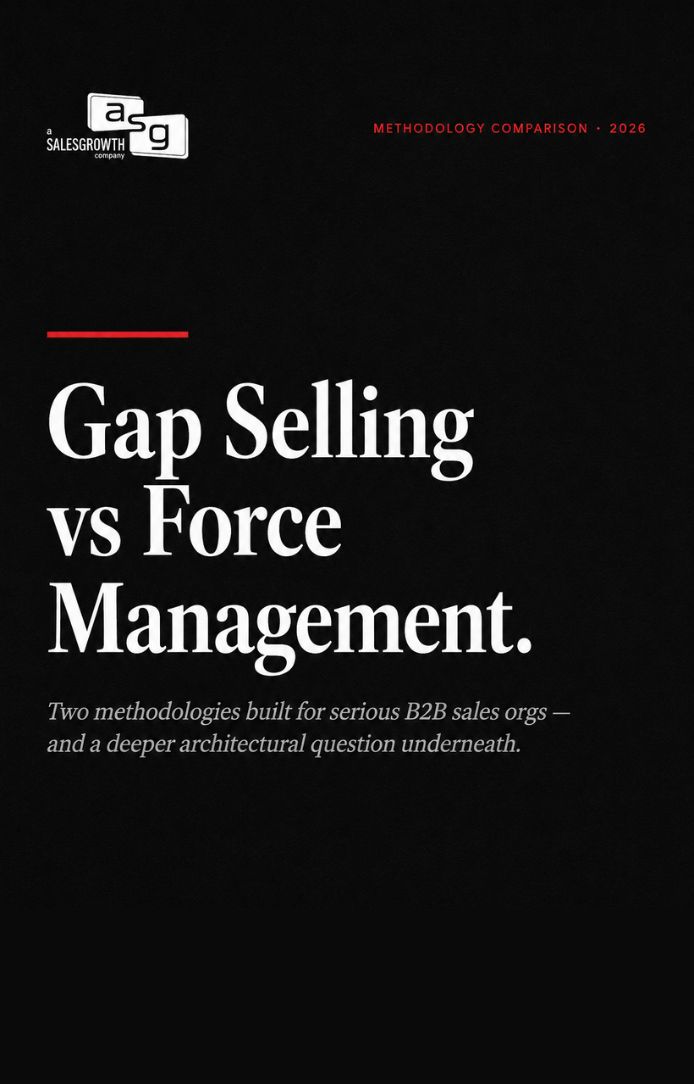
Gap Selling vs. Force Management: One Side of the Decision Frame or Both
What each one is built for, where each produces results, and how to make the right call for your team.
Gap Selling and Force Management are the two methodologies that come up when a serious enterprise B2B sales org is done with tactical training and ready to invest in something structural. Both are diagnostic. Both qualify rigorously. Both have earned genuine credibility with sophisticated revenue teams.
The comparison runs at two levels and most teams only look at one of them.
At the methodology level: Force Management trains reps to articulate the future state — the Positive Business Outcome the buyer wants and the Required Capabilities a solution must deliver to produce it. The future state is clear, the value message is consistent, and the qualification is documented. What the methodology doesn’t structurally require is the systematic surfacing of the current state across three diagnostic layers. Force Management covers one side of the buyer’s decision frame. Gap Selling covers both.
At the systems level: Force Management is an 18–24 month cross-functional change-management initiative — $230K–$475K Year 1 — built for enterprise SaaS orgs with buying committees, complex GTM motions, and the budget to align sales, marketing, product, and customer success around a unified value language. Gap Selling plus the Problem-Centric™ Operating System is a single methodology with a single rubric, built for any size org, that runs problem-centricity from first outbound through renewal. One slice of the revenue motion versus the whole thread.
The decision between them is more specific than brand recognition or customer lists. This guide makes it concrete.
Download the Guide
Force Management runs value-message alignment in the selling motion. Gap Selling runs Problem-Centric™ methodology from prospecting to retention. One side of the decision frame versus both sides — and at the deal level, value articulation versus the calculated Gap. This guide explains the difference and helps you pick the right one for your team.
What’s Inside
Ten sections on the architectural difference between a value-articulation system and a gap-calculation methodology — and what that difference produces at the deal level, the team level, and the systems level.
What Each One Is
Force Management is not a single methodology — it's a stack of three frameworks delivered by a B2B sales consulting firm founded in 2003 by former PTC executives. Command of the Message handles value articulation. Command of the Sale handles process discipline. MEDDICC handles qualification. Gap Selling is one methodology with one rubric: diagnose the buyer's current state across three layers, map the future state, and calculate the Gap between them. The Gap is the cost of inaction. The Gap is the value of the sale. Understanding the architectural difference between a stack and a single rubric is where the comparison actually starts.
The Decision Teams Never Name
When teams evaluate Force Management and Gap Selling they compare the customer lists, the price points, the cross-functional scope. That comparison misses the actual decision: do you want reps trained to articulate one side of the buyer's decision frame — the future state and what's required to deliver it — or trained to calculate both sides and the gap between them, where the decision to change actually gets made?
Why These Methodologies Exist
Force Management was built because even sophisticated SaaS sales teams were losing deals to GTM misalignment — sales saying one thing, marketing another, product a third. The fix was unified value language across every customer-facing function. Gap Selling was built because misalignment isn't the mechanism that causes a buyer to fund a deal. Buyers fund deals when their current state becomes untenable. Both diagnoses are legitimate. They solve different problems.
Side by Side
Both methodologies compared across eleven dimensions: core question, where the current state lives, diagnostic unit, methodology shape, foundational artifacts, underlying philosophy, buyer experience, implementation horizon, best company size, risk when executed poorly, and best fit. The comparison is specific enough to hold against your actual budget, timeline, and team structure.
Where Force Management Produces Results
Four places Force Management genuinely earns its reputation: cross-functional GTM alignment that no other methodology firm attempts at the same depth, enterprise pedigree built across Snowflake, MongoDB, Databricks, Cisco, and Salesforce, the PBO and Required Capabilities framing which is one of the most precise ways to express future state in the market, and the Customer Verifiable Outcome concept which correctly grounds forecast confidence in buyer actions rather than rep self-reporting.
Where Gap Selling Pulls Ahead
The Gap is the deal. Force Management articulates the future state and checks the current state through MEDDICC's qualification layer — as a checkbox, not a diagnosis. A rep can fully qualify MEDDICC and still stall at proposal because the buyer never felt anything untenable. Four places Gap Selling produces outcomes Force Management structurally can't, including why one methodology versus a stack of three frameworks changes ramp time, coaching velocity, and the operational lift your enablement team carries year after year.
What Happens to Your Team
Six downstream effects: what the rep does in the buyer's office and what the buyer leaves with, what consistency looks like when the standard is value-message uniformity versus diagnostic uniformity, what the deal review looks like when the diagnostic unit is a MEDDICC scorecard versus a quantified BID, what managers spend their time coaching across one rubric versus three frameworks, how fast new hires contribute when fluency requires three frameworks versus one, and what your enablement team maintains every year to keep each methodology current.
The Diagnostic Checklist
Reps articulating value well but deals stalling at proposal. MEDDICC scorecards fully checked but forecasted deals slipping quarter over quarter. Onboarding taking nine months or more to get a new rep fluent on the full stack. Your CRM has 15 or more MEDDICC fields per deal and reps skip half of them under quota pressure. Each symptom maps to a specific failure mode and a specific fix.
The Trap Teams Fall Into
Force Management gets chosen because enterprise prestige travels — Snowflake uses it, MongoDB uses it, Databricks uses it, and when a CRO moves from one of those companies to yours the methodology often arrives by default. Gap Selling gets chosen because a sales leader read the book and got convinced. Neither is the right basis for the decision.
What Makes a Methodology Stick
Force Management knows every methodology fades — which is why their engagements are 18–24 month change-management initiatives with continuous reinforcement built in. Even with that investment, published research shows methodology adherence dropping from 70–80% to 40–50% within six months without dedicated reinforcement. The operating layer underneath the methodology isn't a program. It's a system.

Who This Is For
This guide is written for revenue leaders who are evaluating Force Management or running it — and need to understand whether the architectural investment matches the problem they’re actually trying to solve.
- CROs and revenue leaders at enterprise SaaS orgs evaluating whether a $230K–$475K Year 1 cross-functional change-management initiative is the right answer to their specific revenue problem — or whether a single diagnostic methodology would produce better results faster
- VPs of Sales whose reps articulate value clearly but whose deals stall at proposal, and who need to understand the structural reason why
- Heads of Enablement managing a multi-framework methodology stack and looking for a more sustainable operating model that doesn’t require continuous cross-functional reinforcement
- GTM leaders and Founders deciding whether to build their revenue motion around value-message alignment or around problem-centric diagnosis from first outbound through renewal
FAQ
What is the difference between Gap Selling and Force Management?
The difference runs at two levels. At the methodology level, Force Management trains reps to articulate the future state — the Positive Business Outcome the buyer wants and the Required Capabilities a solution must deliver to produce it. Gap Selling trains reps to calculate the Gap: the current state diagnosed across three layers (Problem, Impact, Root Cause), the future state, and the calculated distance between them. Force Management covers one side of the buyer's decision frame. Gap Selling requires both sides plus the math between them. At the systems level, Force Management is an 18–24 month cross-functional change-management initiative; Gap Selling plus the Problem-Centric™ Operating System is a single methodology with a single rubric that runs from prospecting through renewal.
What is Command of the Message?
Command of the Message is the core methodology at the center of Force Management's framework stack. It organizes around Positive Business Outcomes — the business results a buyer wants to achieve — and the Required Capabilities a solution must deliver to produce those outcomes. The methodology trains every customer-facing function — sales, marketing, product, customer success — to use the same value language when speaking with buyers. The goal is cross-functional GTM alignment: every rep, every marketer, every CS conversation reinforces the same PBO and RC framing. Command of the Message is future-state focused. The current state enters the picture at the qualification layer through MEDDICC, not through the methodology itself.
What is a Positive Business Outcome in sales?
A Positive Business Outcome — PBO — is the specific business result a buyer wants to achieve by implementing a solution. It's Force Management's way of expressing the future state in the buyer's terms rather than the seller's terms. A PBO is not a product feature and not a solution capability. It's the business-level outcome the buyer is trying to reach — revenue growth, cost reduction, risk mitigation, time savings — stated at a level the economic buyer would recognize as meaningful. Force Management pairs PBOs with Required Capabilities: the specific things a solution must do to deliver the PBO. Together, PBO and RC form the core of the Command of the Message framework. Gap Selling uses a similar future-state structure inside the broader gap calculation — the future state is required — but the methodology starts with the current state diagnosis, not the future state articulation.
What is MEDDICC and how does it relate to Force Management?
MEDDICC is a qualification framework — not a Force Management invention, but one Force Management has heavily popularized and typically bundles with Command of the Message as a single offering. The letters stand for Metrics, Economic Buyer, Decision Criteria, Decision Process, Identify Pain, Champion, and Competition. MEDDICC helps reps confirm whether a deal is qualified at each stage by checking key factors about the buyer's decision process. Force Management layers MEDDICC on top of Command of the Message to add qualification rigor to the value-articulation methodology. The limitation is structural: MEDDICC's "I" — Identify Pain — is a checkbox. It asks whether pain was found, not how to walk three diagnostic layers or quantify impact at the organizational level. A rep can check the box with root-cause-level pain and call the deal qualified, then watch it stall because the buyer never felt the impact layer that funds change.
What is the difference between MEDDICC and Gap Selling?
MEDDICC is a qualification framework — it confirms whether a deal meets certain criteria. Gap Selling is a diagnostic methodology — it surfaces and quantifies the buyer's untenable current state. The two operate on different parts of the sales problem. MEDDICC asks: is this deal real? Gap Selling asks: does this buyer feel the cost of staying put? MEDDICC's "Identify Pain" step confirms pain exists somewhere. Gap Selling's three-layer diagnostic — Problem, Impact, Root Cause — walks the rep to the specific layer where change gets funded and requires quantified impact at the org level before the diagnosis is complete. Many teams run MEDDICC and Gap Selling together: MEDDICC handles deal qualification rigor, Gap Selling handles diagnostic depth at the current-state layer.
What are Customer Verifiable Outcomes in Force Management?
Customer Verifiable Outcomes — CVOs — are Force Management's way of qualifying deal stage based on what the buyer actually does rather than what the rep claims is happening. Each stage of the sales process has a CVO — a specific, observable action the buyer takes that confirms real intent to move forward. Rather than advancing a deal because the rep feels good about the relationship, CVOs require the rep to point to buyer behavior that verifies stage progression. It's one of the sharpest pieces of thinking in the Force Management stack, and it aligns with Gap Selling's position: forecast confidence should come from buyer actions, not rep self-reporting.
Can you run Force Management and Gap Selling together?
They are compatible at the systems level and complementary at the deal level. Force Management's Command of the Message provides the future-state articulation framework — PBOs and Required Capabilities — that Gap Selling's future-state layer maps naturally onto. MEDDICC's qualification rigor can run alongside Gap Selling's diagnostic rubric without conflict. The practical challenge is cognitive load: reps managing Command of the Message, MEDDICC, and Gap Selling's BID simultaneously face three vocabularies and three frameworks in every deal review. The more workable approach for teams that have invested in Force Management is to use Gap Selling's three-layer diagnostic to fill the current-state gap that MEDDICC's "Identify Pain" checkbox leaves open.
What is the Problem-Centric Operating System?
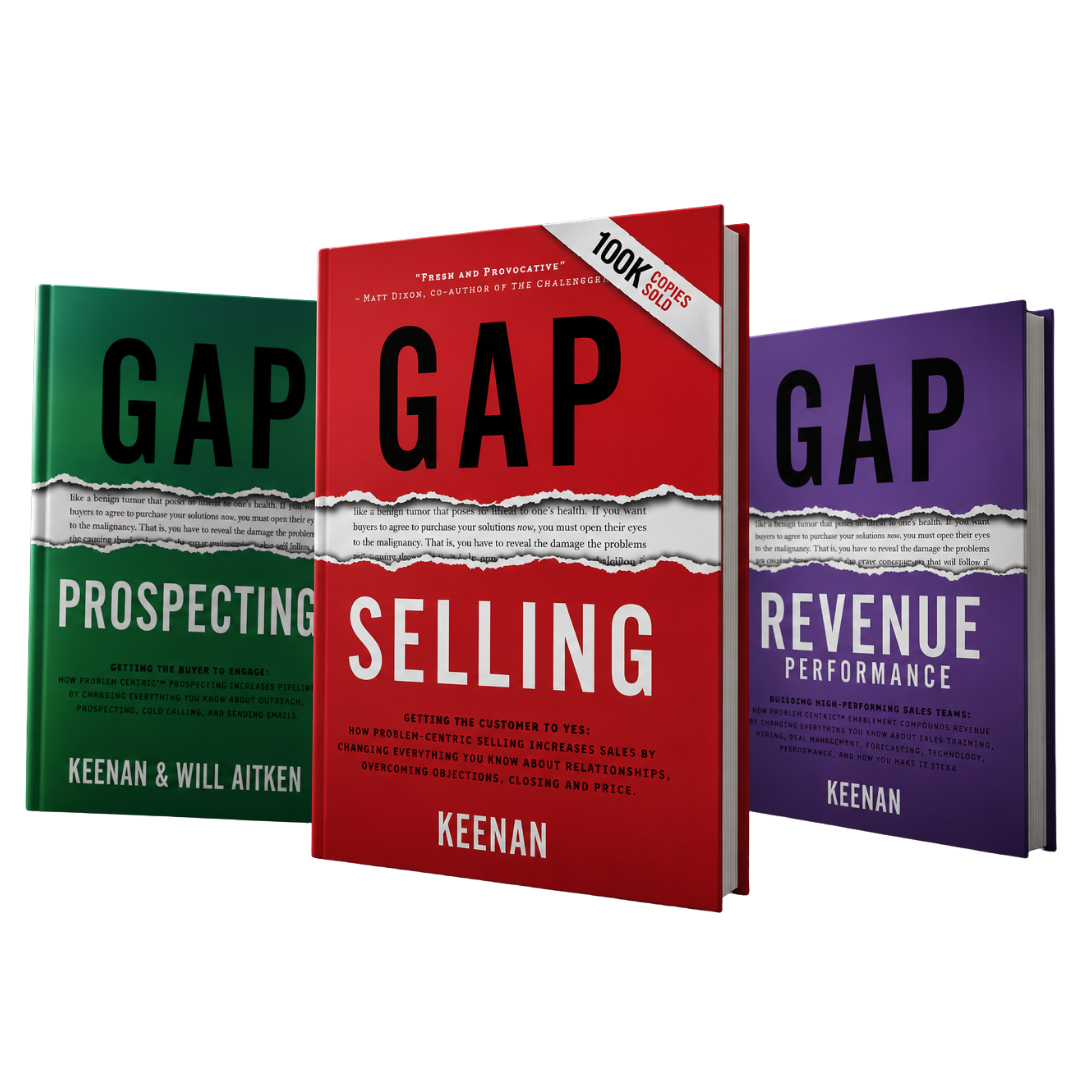
What is Gap Prospecting?
Gap Prospecting is the outbound layer of ASG's Problem-Centric™ system. It applies the same problem-centric diagnostic logic to prospecting that Gap Selling applies to the deal cycle. Instead of prospecting around product features or company attributes, Gap Prospecting targets buyers who likely have the specific problems the company solves — using the PIC as the prospecting target map. Every cold call, every outbound email, every account plan starts with the problem. Gap Prospecting is one of four pillars of the Problem-Centric™ system, alongside Gap Selling, Gap Customer Care, and the PCOS. Force Management doesn't have an equivalent — the methodology enters at the qualified opportunity stage.
About A Sales Growth Company
A Sales Growth Company builds sales training and consulting programs based on Gap Selling and the Problem-Centric™ Operating System — the only methodology family that runs problem-centricity through the entire revenue motion, from first outbound through renewal. The work is built on one premise: buyers don’t change because value is articulated clearly. They change when their current state becomes untenable and someone helps them calculate what that costs.
This guide was built from 25 years of consulting across hundreds of B2B sales organizations. A Sales Growth Company is a Representative Vendor in the 2025 Gartner Market Guide for Sales Training Service Providers.
Talk to Us About Training
We can walk through how your team approaches training today, the issues limiting behavior change, and the conditions that shape execution in live opportunities.