
Gap Selling or Sandler: Which Sales Methodology Fits Your Team?
What each one diagnoses to, where each produces results, and how to make the right call for your team.
Gap Selling and Sandler are the two diagnostic methodologies sales leaders compare when they’re done with relationship selling and done with insight delivery and want something built on actual diagnosis. The comparison looks straightforward from the outside. Both methodologies reject high-pressure tactics. Both put the buyer’s problem ahead of the pitch. Both produce reps who ask better questions than the average seller.
The difference lives one level below that surface. Sandler was built on the psychology of the conversation — David Sandler partnered with a clinical psychologist in 1967 and grounded the methodology in Transactional Analysis, a framework that maps how ego states shape what happens between two people in a room. The methodology trains reps to control that room: manage their own psychology, run the seven-step Submarine, and drill through the Pain Funnel until the buyer surfaces something that hurts. The diagnosis is complete when pain is found.
Gap Selling was built on the psychology of the decision. Every sale asks a buyer to change — to move from a current state they know to a future state they don’t. Behavioral science has known for decades that people don’t make that move until the current state becomes untenable. Not uncomfortable. Not painful in the abstract. Untenable. Gap Selling gives reps a three-layer diagnostic — Problem, Impact, Root Cause — because pain at the root-cause layer fades by Friday while pain at the impact layer is what funds change. Sandler’s Pain Funnel doesn’t structurally require the rep to reach the impact layer. Gap Selling’s rubric makes stopping there impossible.
This guide explains both methodologies, where each produces results, and how to make the right call for the team in front of you.
Download the Guide
Sandler hunts for pain. Gap Selling walks a buyer through Problem, Impact, and Root Cause. One finds something that hurts. The other surfaces the layer where change gets funded. This guide explains the difference and helps you pick the right one for your team.
What’s Inside
Ten sections on the structural difference between pain-based diagnosis and three-layer diagnosis — and what that difference produces inside your pipeline, forecast, and rep ramp.
What Each One Is
Sandler is a seven-step sequential process built on Transactional Analysis — Eric Berne's 1950s framework mapping Parent, Adult, and Child ego states. The seven steps form a Submarine: Bonding and Rapport, Up-Front Contracts, Pain, Budget, Decision, Fulfillment, Post-Sell. Each compartment seals behind the rep so the buyer cannot retreat. Gap Selling has no sequential steps. Three things to find on every call: the Problem, the Impact at the organizational level, and the Root Cause keeping the buyer in their current state. Understanding what each methodology is built on is the prerequisite for making the right call.
The Decision Teams Never Name
When teams compare Sandler and Gap Selling they look at the seven steps versus the three layers, the franchise network versus the centralized firm, the script library versus the PIC. That comparison frames the wrong question. The real decision is whether you want reps trained to find pain or trained to walk a buyer to the specific diagnostic layer where change gets funded. One produces pipeline entries. The other produces diagnosed deals with quantified impact in the buyer's own words.
Why These Methodologies Exist
Both were built because high-pressure selling stopped working. From there they diverged at the level of orientation. Sandler's psychology faces the rep — control the conversation, manage your ego state, run the script. Gap Selling's psychology faces the buyer — what does it take for this specific human being to decide that staying put is worse than moving. That difference in orientation determines where each methodology's energy goes and what it leaves unresolved.
Side by Side
Both methodologies compared across eleven dimensions: core question, diagnostic unit, process shape, foundational artifacts, underlying psychology, rep posture, buyer experience, tactical moves, coaching cycle, delivery model, and best fit. The comparison is specific enough to evaluate against your actual team structure rather than in the abstract.
Where Sandler Produces Results
Sixty years of accumulated tactical refinement, a disqualification discipline that is genuinely rare in the methodology market, and rep psychology work — I/R Theory, head trash, the BAT triangle — that no other methodology tries to match in depth. Three conditions where Sandler earns its reputation, with the mechanism behind each and why those conditions are narrower than they appear during the evaluation process.
Where Gap Selling Pulls Ahead
The Pain Funnel has one structural failure: it doesn't require the rep to reach the layer that funds change. A rep surfaces root-cause pain, the buyer acknowledges it, the rep marks the diagnosis complete — and the deal stalls because nothing existential was surfaced. Three places Gap Selling produces outcomes Sandler structurally cannot, including why the complete absence of tactical moves is the competitive advantage when modern buyers can detect the script.
What Happens to Your Team
Six downstream effects: what the rep does in the buyer's office and what the buyer feels, what consistency looks like across 220 franchise locations versus a single firm, what the deal review looks like when the diagnostic unit is pain versus a quantified BID, what managers coach to and how fast that produces results, how fast new hires contribute, and what your enablement team maintains every quarter to keep each methodology current.
The Diagnostic Checklist
Reps surfacing pain on every call but deals stalling before procurement. Forecast confidence that tracks who is reporting rather than what is in the deal. Buyers telling you they felt managed during the sales cycle. A script library your enablement team cannot keep current. Each symptom maps to a specific failure mode and a specific fix.
The Trap Teams Fall Into
Sandler gets chosen because it has institutional gravity — 1967, global franchise, past employers used it. Gap Selling gets chosen because a sales leader read the book and got convinced. Neither is the right basis for the decision, and both produce rollouts that fail for the same reason.
What Makes a Methodology Stick
Sandler's franchise model has kept the methodology alive in organizations long after the initial training ended. A trainer showing up every quarter is not the same as the methodology showing up in every deal review. The operating layer each methodology requires is completely different in scope, cost, and what happens when those inputs stop.

Who This Is For
This guide is written for revenue leaders who are running Sandler or evaluating it — and need an honest read on whether it’s the right methodology for the team and buyer in front of them today.
- CROs and revenue leaders who adopted Sandler because it was the safe institutional choice and are now questioning whether it’s producing the forecast accuracy and deal consistency they need
- VPs of Sales whose reps surface pain on every call but whose deals stall before procurement and need to understand the structural reason why
- Heads of Enablement maintaining a Sandler script library that requires constant refresh and are looking for a more sustainable operating model
- Founders and CEOs building a sales motion from scratch who want to understand whether a 1967 methodology built on 1950s psychology fits the buyer they’re selling to in 2026
FAQ
What is the difference between Gap Selling and Sandler?
The difference is what each methodology trains reps to diagnose to. Sandler trains reps to find pain. The Pain Funnel drills from broad problems toward emotional pain, and the diagnosis is complete when the rep finds something that hurts. Gap Selling trains reps to walk a buyer through three distinct diagnostic layers — Problem, Impact, and Root Cause — where each layer plays a specific role. Problem names what is broken. Impact names what that costs the organization — the layer where buyers fund change. Root Cause names the underlying condition keeping the buyer in their current state. Sandler doesn't structurally require the rep to reach the impact layer. Gap Selling's rubric makes stopping at root-cause pain impossible because the BID isn't complete until impact is quantified at the org level. That structural difference is what shows up in close rates and forecast accuracy.
What is the Sandler Pain Funnel?
The Pain Funnel is Sandler's signature diagnostic tool — a sequence of questions designed to drill from broad surface problems toward emotional pain. It moves from open questions about what isn't working, to probing questions about the impact of that problem, to deeper questions about how the buyer feels about it personally. The Pain Funnel's strength is that it pushes reps past surface symptoms toward something that genuinely hurts. Its structural limitation is that it uses a single category — pain — across three layers of a buyer's situation that are not equivalent. Pain at the root-cause layer ("our system is slow") doesn't motivate change. Pain at the impact layer ("we'll miss our growth target") does. The Pain Funnel doesn't require the rep to distinguish between the two.
What are the seven steps of the Sandler Selling System?
The seven steps form what Sandler calls the Submarine — a sequential process where each compartment seals behind the rep so the buyer cannot retreat to an earlier stage. The steps are: Bonding and Rapport, Up-Front Contracts, Pain, Budget, Decision, Fulfillment, and Post-Sell. The Up-Front Contract sets the agenda, purpose, and outcome of the meeting before substantive conversation begins. Pain is the diagnostic core. Budget and Decision qualify whether the deal can actually close. Fulfillment is the solution presentation, which Sandler delays until Pain, Budget, and Decision are confirmed. Post-Sell addresses buyer's remorse before it surfaces. The strength of the Submarine is its qualification discipline — reps who run it correctly spend less time on deals that were never real.
What is the difference between pain and impact in sales?
Pain and impact describe different layers of a buyer's problem and they produce different buying behaviors. Pain at the root-cause layer — "our processes are manual," "the system is slow," "reporting takes too long" — is real but it doesn't motivate change. The buyer acknowledges it, feels it during the meeting, and moves on. Pain at the impact layer — "we'll miss our growth target," "we can't scale without fixing this," "our valuation will drop if this continues" — is existential. It threatens something the buyer cannot afford to lose. That's the layer that funds change. Methodologies that use pain as a single diagnostic category leave it to the rep's instinct to find the right layer. Gap Selling's three-layer rubric — Problem, Impact, Root Cause — forces the rep to reach the impact layer by making it a required component of the diagnosis.
What is Buyer Input Data in Gap Selling?
Buyer Input Data — the BID — is the per-deal diagnostic record a rep builds during discovery. It captures the buyer's own words on three things: the Problem they are experiencing, the Impact that problem is producing at the organizational level, and the Root Cause keeping them in their current state. The BID maps back to the company's master Problem Identification Chart — the PIC — which catalogs every business problem the company solves, the root causes underneath each one, and the impacts each produces. A complete BID is the standard for a diagnosed deal. An incomplete BID — missing rows on Impact or Root Cause — tells the manager exactly what hasn't been uncovered and why the deal may stall. That's what makes Gap Selling forecasts diagnostic rather than narrative.
What is a Problem Identification Chart in Gap Selling?
The Problem Identification Chart — the PIC — is the company's master diagnostic map. It catalogs the business problems the company solves, the root causes underneath each problem, and the impacts each produces at the organizational level. The PIC is built once with the company's leadership and refined quarterly. It arms reps with the language to ask the right questions on every call. Without a PIC, reps don't know which problems to surface or which impacts to quantify. Building the PIC is a one-time strategic exercise. Maintaining it is a quarterly refinement. That is a fundamentally different enablement burden than maintaining a Sandler tactical script library, which requires continuous refresh as buyer behavior evolves.
Is Sandler still effective in 2026?
Sandler's core strengths are durable. Sixty years of accumulated tactical depth, a disqualification culture that is genuinely rare in the methodology market, and rep psychology work that no other methodology tries to match — those are real. The structural limitations don't disappear with age. The Pain Funnel doesn't require reps to reach the impact layer, which means a clean Sandler call can produce a stalled deal because the buyer only felt nuisance-level pain. The tactical moves — negative reverse, dummy curve, up-front contract sequencing — are detectable by buyers who have read the same blogs and sales training content the rep has. The franchise delivery model means the quality of a Sandler engagement depends heavily on which franchise location a team selected. Sandler works well when a team needs tactical script depth and rep psychology training. It works less well when the primary problem is diagnostic rigor and forecast accuracy.
Can you use Gap Selling and Sandler together?
The concepts are not mutually exclusive. A rep running Gap Selling can incorporate Sandler's disqualification discipline and rep psychology work as supplementary training — I/R Theory and head trash work add something Gap Selling doesn't explicitly address. Running both as co-equal diagnostic systems creates a different problem: reps and managers lose clarity on what the standard is. When a deal stalls, the manager is asking both "did we get to Impact?" and "did we run the Pain Funnel?" — two rubrics, two standards, one confused team. The workable approach is Gap Selling as the primary diagnostic system with selective use of Sandler's rep psychology and disqualification frameworks where they fill a genuine gap.
How long does it take to ramp a new rep on Sandler vs. Gap Selling?
Sandler ramp is typically six to nine months before a new rep can execute the full methodology fluently. The seven sequential steps, the Pain Funnel choreography, the up-front contract patterns, and the mindset work all have to be internalized before a new hire can run a clean call. Gap Selling ramp is shorter because the rubric is three things to find on every call rather than seven steps to choreograph. A new rep can run a meaningful diagnostic within weeks. Impact quantification sharpens over time and deeper root cause identification develops with experience, but the diagnostic structure itself is teachable regardless of tenure or industry background.
What is the Problem-Centric Operating System?
About A Sales Growth Company
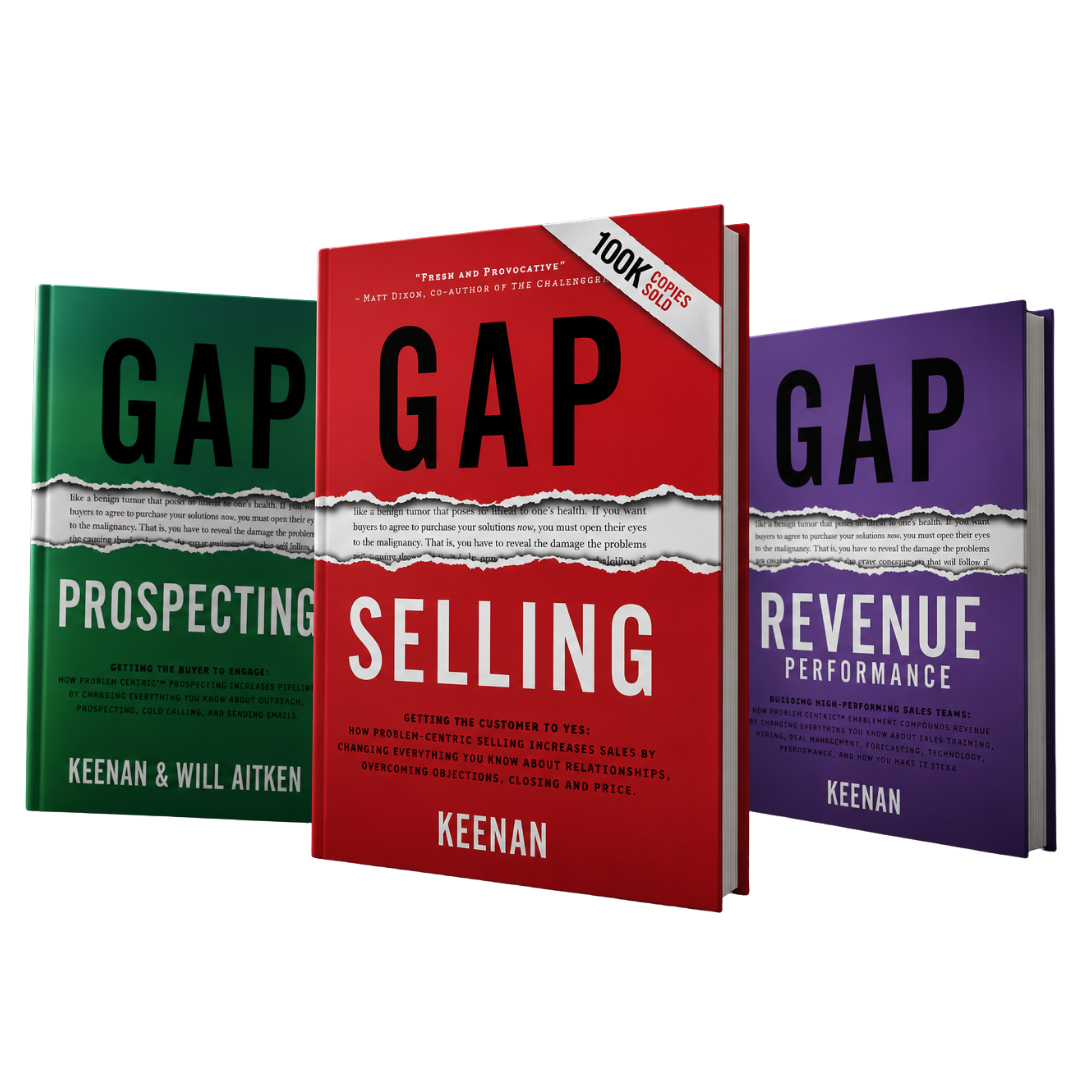
A Sales Growth Company builds sales training and consulting programs based on Gap Selling and the Problem-Centric™ Operating System. The work is built on one premise: buyers don’t change because reps are well-trained — they change when a rep surfaces an untenable current state and demonstrates a credible path to something better. Getting that diagnosis right, consistently, across every rep on the team, is what ASG builds.
This guide was built from 25 years of consulting across hundreds of B2B sales organizations. A Sales Growth Company is a Representative Vendor in the 2025 Gartner Market Guide for Sales Training Service Providers.
Talk to Us About Training
We can walk through how your team approaches training today, the issues limiting behavior change, and the conditions that shape execution in live opportunities.