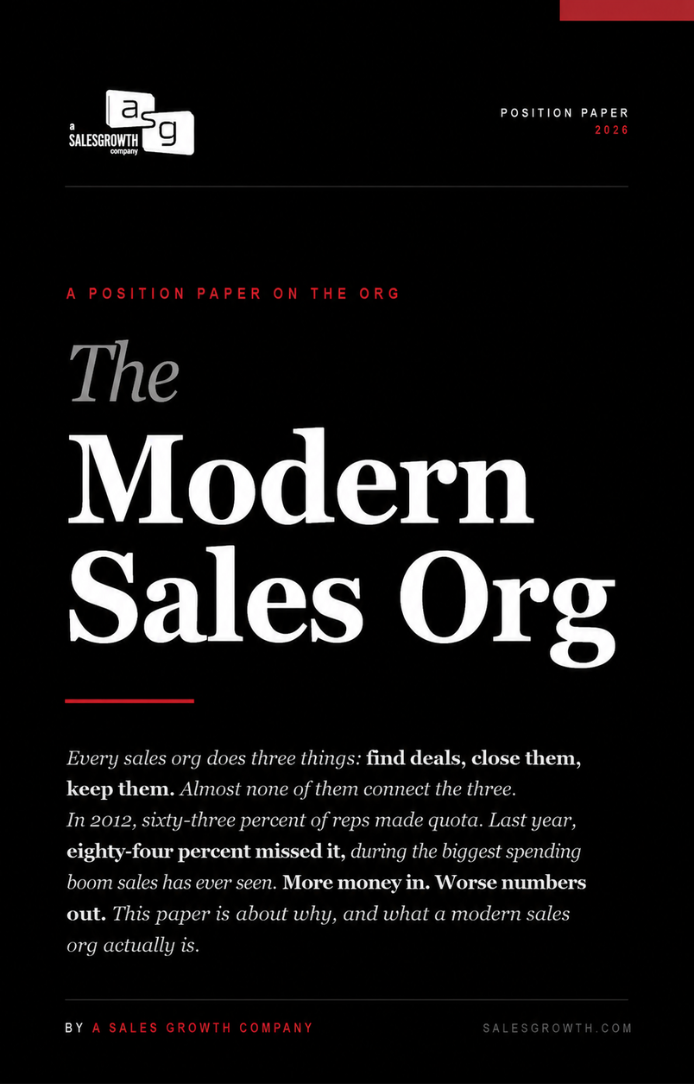
The Modern Sales Org
Every sales org does three things: find deals, close them, keep them. In 2012, 63% of reps hit quota. Last year, 84% missed it. Companies spent more money on sales than ever before. Results got worse. This paper explains why, and what a sales org can do about it.
In 2012, 63% of sales reps hit quota. Last year, only 16% did. Companies spent more money on sales during that time than ever before. Spending more did not fix it.
A sales org has three jobs: find deals, close deals, keep the customer. Those are usually three different teams. The buyer has one problem the whole time, but that problem often gets lost between teams. The rep who finds the deal knows the buyer's problem. The rep who closes the deal may not know it. The team that manages the account after that may never learn it at all.
When the buyer's problem gets lost, deals take longer to close, or do not close at all. Renewals are harder to predict. This is why quota attainment keeps falling, even with more spending.
A modern sales org tracks the buyer's problem from the first call through renewal. It tracks what each rep, manager, and BDR does. It tracks how that work changes what the buyer understands about their problem. This paper explains why quota attainment keeps falling. It explains the four ways a sales org can fail. It explains how to build one that does not fail.
Download the Paper
An org chart tells you who reports to whom. It says nothing about whether any of it connects. Two disconnects run through nearly every sales org: one sideways across the three teams that find, close, and keep customers, one down inside how each team actually trains, coaches, and measures itself. Together they turn three teams into three companies sharing a logo. Random, Heroic, and Peacock orgs all run on muscle instead of a system, and muscle has a shelf life of about eighteen months. This paper names both disconnects and what it takes to build the org that doesn't need either one.
What's Inside
Eight sections building one argument: sales orgs are disconnected in two directions, muscle is the only thing left once nothing connects, and there's a fourth operating state almost none of them build toward.
The Heroic Paradox
A CRO too busy making the number to fix the thing that makes the number. The org thinks it's crushing it. It's muscling it, quarter after quarter, until the day it can't, which shows up about every eighteen months, right before the next leader picks up the same rope.
The Org Chart Is Not a System
SDRs, AEs, and CS look like a complete system on a chart. They're three companies sharing a logo: three scoreboards, three languages, nobody owning the seams between them. A second disconnect runs underneath. Inside each team, train, execute, and measure barely know each other.
The Questions No One Asked When It Was Built
Six blunt diagnostic questions, on qualification criteria, onboarding, manager coaching, CRM stages, and the handoff into customer success, that expose whether your sales org was ever built as one system or bolted together one decision at a time.
Where the Buyer's Problem Dies
Every piece of a disconnected org points at itself: your product, your pipeline, your quota, your stages. The buyer's actual problem is supposed to travel from the first call to the last renewal. Instead it dies at every handoff, and the QBR two years later can't say what the customer bought you to fix.
Random, Heroic, Peacock, and the Fourth
Every org that runs on muscle instead of a system ends up looking like one of three things. Random: everyone sells differently. Heroic: the leader closes the deals the reps couldn't. Peacock: a beautiful tech stack and a win rate that hasn't moved in years. There's a fourth: Compounding, the only one that gets everything out of find, close, and keep.
The Method Comes First
A modern sales org runs on a method chosen before the CRM, before the org chart, before one more tool. Everything else, stages, coaching, comp, the forecast, gets rebuilt around it. Skip that step and you don't have a method, you have a poster on the wall.
Deploying Is Not Executing
Installing a tool, running a training, launching a playbook: none of that is executing. It's deploying. Executing means every one of those things actually gets used and actually produces the result it was bought for. Most orgs are good at deploying and bad at executing.
Fifteen Years of Spending More for Less
In 2012, 63% of reps made quota. In 2024, 84% missed it, during the biggest sales-tech spending boom in history. More tools, more training, more AI, and the line never bent. That's the proof: the fix was never one more purchase away.

Who This Is For
This paper is for revenue leaders who suspect their sales org is working harder than it should have to, and want to see exactly why.
- CROs and VPs of Sales who are hitting the number through heroics and already know it, and want to see what building a real system instead would take
- RevOps and Sales Ops leaders who own the CRM stages, the deal reviews, and the forecast, and want to understand why none of it adds up to a system
- Sales enablement leaders who have shipped methodology training that didn't stick, and want to see the difference between deploying a method and executing one
- CEOs and board members evaluating why sales spending keeps climbing while quota attainment keeps falling, and what's actually driving the gap
FAQ
What is "the great sales disconnect"?
Two separate breaks that run through almost every sales org at once. One runs sideways: SDRs, AEs, and CS each optimize for their own metrics and rarely pass the buyer's actual problem to the next team. One runs down: inside each team, training, coaching, and results don't feed each other. Most orgs have both, and neither shows up on an org chart.
What are the Four Orgs, Random, Heroic, Peacock, and Compounding?
ASG's model for the operating states a sales org falls into when it runs on muscle instead of a system. Random: every rep sells differently and nothing repeats. Heroic: the number gets muscled in at the buzzer by a few people carrying the team. Peacock: a beautiful tech stack and process with a win rate that never moves. Compounding is the fourth state, a connected system that gets better every quarter without anyone playing hero.
What's the difference between deploying a method and executing it?
Deploying is buying the tool, running the training, launching the playbook. Executing is making sure it actually gets used and actually produces the result it was bought for. Most sales orgs are good at deploying and bad at executing. A Peacock org is the result: a warehouse of things that got deployed and never executed.
Where do the 63% and 84% quota attainment numbers come from?
63% of reps made quota in 2012 (CSO Insights, now Korn Ferry, Running Up the Down Escalator, 2017). 84% missed quota in 2024, roughly one in six made their number (Salesforce, State of Sales, 6th ed., 2024). The two figures come from different research houses measuring the same thing and are presented together to show the trajectory, not as a single continuous dataset.
Is this specific to Gap Selling, or does it apply to any sales methodology?
The argument applies regardless of which method a sales org runs: Gap Selling, MEDDIC, Challenger, Sandler, Command of the Message, or a proprietary one. The method has to be chosen first and the rest of the org rebuilt around it. Which one matters less than whether everything else is actually wired to it.
How is a connected sales org different day to day?
It's self-diagnosing. When a number slips, forecast accuracy, win rate, renewal rate, a connected org can trace the break to its source: which deals cleared the bar, which managers stopped holding the line, where coaching stopped matching what was trained. A disconnected org just buys another tool and hopes.
Is fixing this a rebuild or a tune-up?
Depends how far off you are. For some orgs it's a tune-up: tightening qualification criteria, rewriting a few CRM fields. For others it's a real project: retraining managers to coach the method, rebuilding CRM stages around the buyer's process, resetting comp.
Who should read this paper?
CROs, VPs of Sales, RevOps and sales enablement leaders, and CEOs or board members who want to understand why sales spending keeps climbing while quota attainment keeps falling, and what actually closes that gap.
About A Sales Growth Company
A Sales Growth Company builds sales training and consulting programs on Gap Selling and the Problem-Centric™ Operating System, the methodology family built to connect find, close, and keep into one system instead of three disconnected jobs.
The firm has worked with B2B sales organizations for 25 years across hundreds of companies. The disconnects named in this paper are the same patterns ASG has spent 25 years helping revenue organizations find and fix. ASG is named a Representative Vendor in the 2025 Gartner Market Guide for Sales Training Service Providers.
Download the Paper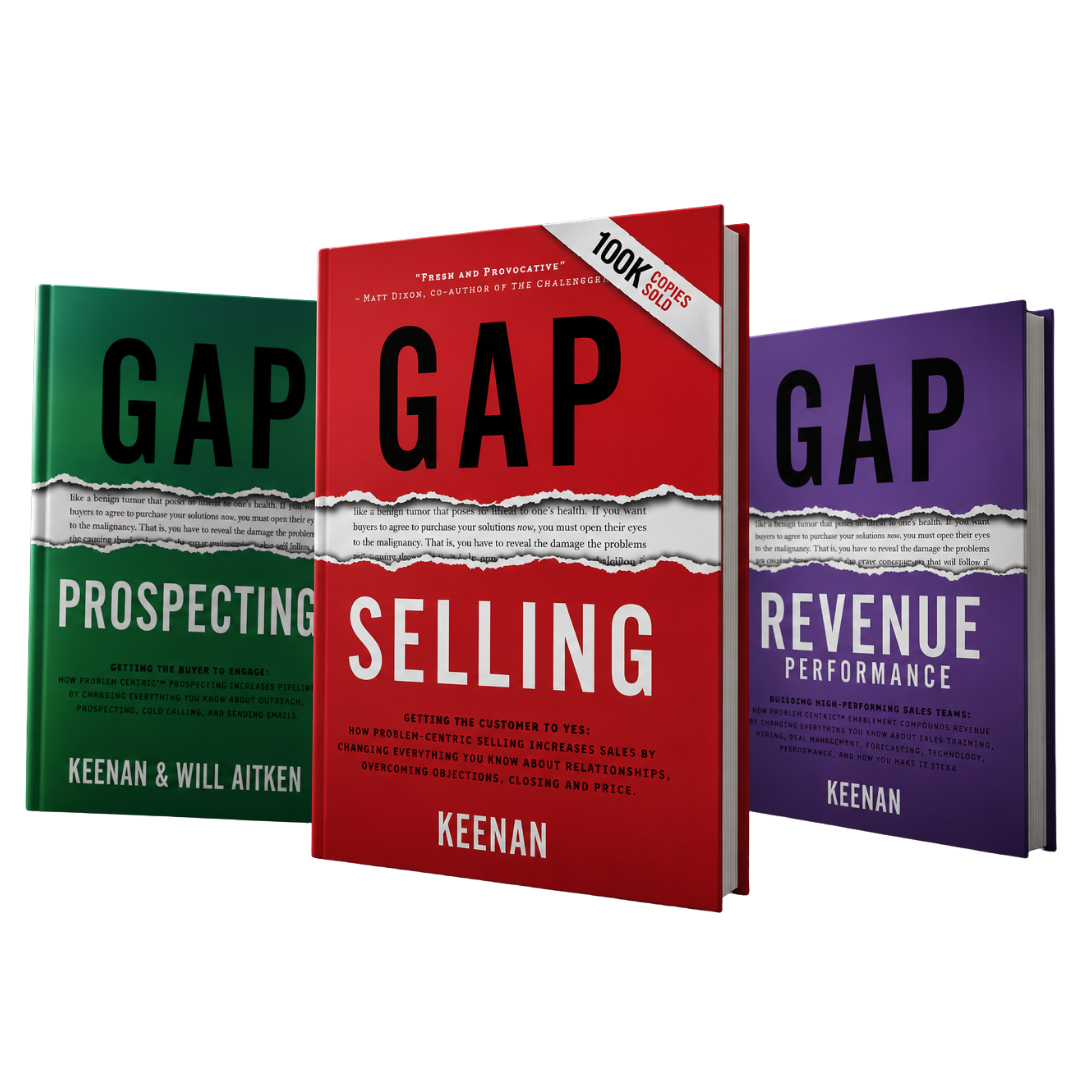
Talk to Us
Want to know which of the four orgs you're actually running? We'll show you where the disconnects are, sideways and down, before you spend another dollar on a fix.
Let's Talk