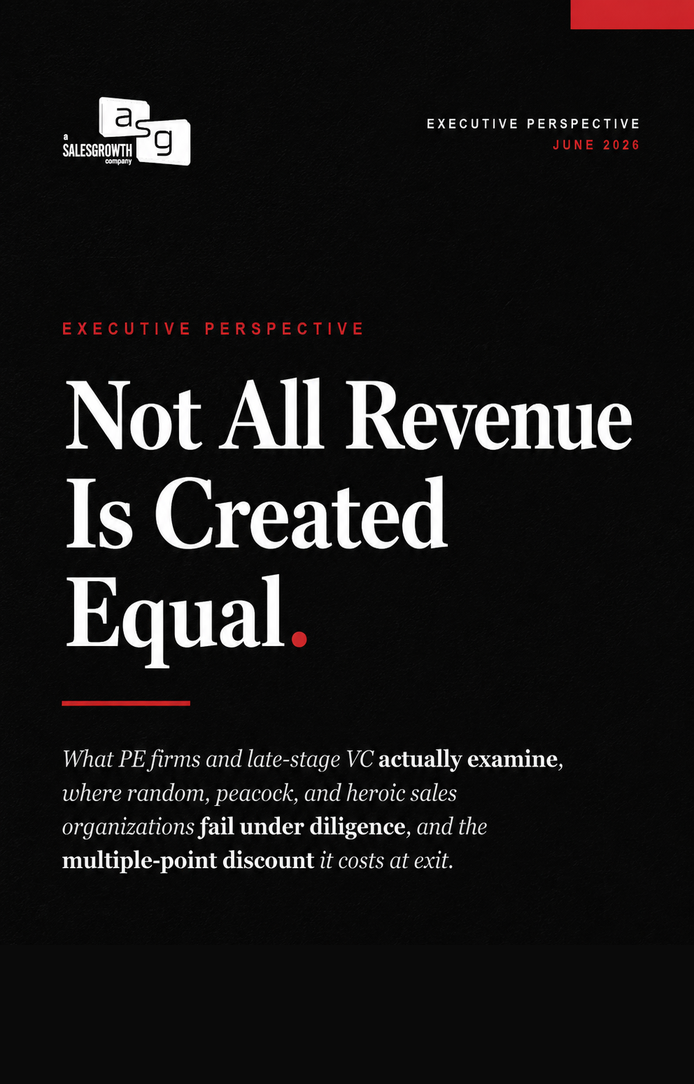
Not All Revenue Is Created Equal
What PE firms and late-stage investors examine inside a sales organization, where random, heroic, and peacock orgs fail under diligence, and the multiple-point discount it costs at exit.
A B2B company hits its revenue target for three years running. Inside the company, the growth story looks intact — the board is pleased and nothing in the quarterly reviews has flagged a problem. Then a buying event arrives — a PE recapitalization, a late-stage VC round, a strategic acquisition — and a commercial diligence team starts asking questions no one prepared for.
The diligence team finds customer concentration too high, and forecast variance running two to three times what comparable peers show. The win rates on committed deals are half what the CRM reported. The end-of-quarter discount pattern looks like revenue pull-forward. A handful of key people control the major accounts, and the sales process lives in the heads of two senior reps, not in a documented system.
None of those findings invalidate the revenue — the number was real and the number was hit. The multiple still came in at 4x instead of 8x, which on a $50M revenue company is a gap of $150M to $400M.
This paper explains what produced that outcome, what a diligence team is examining when it prices the discount, and what a sales organization has to build before the buyer arrives to earn the premium instead.
Download the Paper
The revenue number shows what a company produced. The diligence team prices what it will produce next — and whether the system underneath the selling motion can do it without the people and conditions that made it possible the first time. Two companies can hit the same $50M in revenue and face a gap of $150M to $400M at exit. The system is the difference. This paper explains what that system looks like, where most sales organizations fail the scrutiny, and what it costs when they do.
What’s Inside
Nine sections on what a commercial diligence team examines inside a sales organization, where most orgs fail that scrutiny, and what the difference is worth at exit.
The Setup: What a Buying Event Reveals
A B2B company hits its revenue target for three years. A PE firm sends in a commercial diligence team, and what looked like a healthy growth story from the inside becomes a different story on the outside. Six specific findings surface in the first week. None of them invalidate the revenue. All of them compress the multiple.
Random, Heroic, Peacock, Compounding
Three patterns produce the findings this paper describes, and most underperforming sales organizations are some blend of all three. The Random org has the inventory of a system but no organizing logic connecting it. The Heroic org makes the number through brute force, borrowing from next quarter to close this one. The Peacock org has built everything a diligence team expects to find on paper — without the inspection layer that makes any of it real. The Compounding org is the absence of all three, and every premium multiple is paid for it.
What Buyers Are Paying For
Historical revenue is a fact. What a strategic buyer or PE firm is purchasing is future revenue — the cash flows their financial model projects forward. This section explains the question every diligence workstream is asking in different forms, and why the answer depends entirely on what is underneath the number.
What "Withstanding Scrutiny" Means
A buying event triggers a level of examination most CEOs and CROs have never been on the receiving end of. The diligence team includes a Quality of Earnings accounting firm that independently recalculates normalized EBITDA from the general ledger, a commercial diligence firm that examines the GTM motion and pipeline, customer reference calls that can run 20 to 50 deep, and cohort analysis of revenue retention and churn. This section maps every workstream and explains what each one is looking for.
The Specific Findings That Reduce Valuation
Five signals, presented in the order PE buyers weight them: key-person dependency, customer concentration, revenue quality and operational maturity, forecast variance, and unit economics. Each finding is examined at three levels — where it shows up in diligence, why sellers consistently miss it internally, and what the system that passes the test looks like.
The Aggregate Picture: What the Gap Costs
A $50M revenue company with a real, documented, predictable system can trade at 8 to 11 times revenue. The same revenue from a random, heroic, or peacock org typically trades at 3 to 5 times. This section puts the total gap in dollar terms and names the specific conditions that determine where a company lands.
The Self-Diagnostic
The four-org taxonomy applied as a scoring tool. Each dimension a diligence team examines becomes a row in a self-assessment the CEO or CRO fills out before the buyer arrives. The conclusion they reach is the same conclusion the diligence team will reach — with the difference that there is still time to do something about it.
Why This Connects to the Modern CRO
The Builder CRO produces the profile that earns the premium multiple. The Hero and the Navigator produce revenue that looks identical on the income statement and fails diligence in measurable ways — concentrated relationships, undocumented playbooks, forecast variance the buyer will price as risk. This section connects ASG's Modern CRO framework to the specific valuation outcomes this paper describes.
What to Do Before the Buyer Arrives
Seven specific actions, each a multi-quarter project that cannot be compressed into the 90 days before a diligence team arrives: reduce key-person dependency, diversify customer concentration, document the sales methodology, manage end-of-period discount patterns, audit forecast variance over the last eight quarters, measure CAC payback and NRR on the sales operating dashboard, and build the manager bench.

Who This Is For
This paper is written for B2B leaders on a path toward a transaction — who want to understand what commercial diligence examines before it arrives.
- CEOs of private B2B companies — on a path toward a PE recap, a strategic acquisition, or a late-stage raise, who want to understand what a commercial diligence team will find before they send one
- CROs and VPs of Sales — who have hit the revenue target and suspect that may not be enough to reach the exit multiple the board has in mind
- PE firms and portfolio company boards — who evaluate revenue health on quarterly attainment figures and want a more precise way to assess whether the system underneath those numbers will hold up under independent scrutiny
- Investment bankers and M&A advisors — who are preparing a company for a transaction and want a framework for diagnosing commercial risk before the diligence team does it for them
- Revenue leaders at PE-backed companies — who are working under a value creation mandate and need to know which changes to the revenue system will move the multiple at exit
FAQ
What is commercial diligence?
Commercial diligence is an independent examination of a company's go-to-market motion conducted by a third-party consulting firm during a PE transaction or M&A process. It runs in parallel with a Quality of Earnings accounting review and examines the sales organization, pipeline, win rates, customer relationships, forecast accuracy, and the durability of the revenue the financial model is projecting forward. The accounting firm reconciles the historical numbers. The commercial diligence firm evaluates whether those numbers will repeat.
Why does the same revenue produce different multiples?
A buyer purchasing a company is not purchasing historical revenue — they are purchasing the cash flows their financial model projects forward. Two companies with identical top lines can produce materially different multiples when the system underneath the revenue differs. One company's revenue comes from a documented, inspectable, repeatable sales motion with distributed relationships and predictable win rates. The other company's revenue comes from three senior reps who hold all the major accounts personally, a forecast that has been wrong by 30% in six of the last eight quarters, and end-of-period discounting that pulled future revenue into the current quarter. Both companies hit the number. The buyer prices the risk differently.
What are the four types of sales organizations?
The paper identifies four patterns: Random, Heroic, Peacock, and Compounding. The Random org has the components of a system — CRM, methodology, process documentation — but no organizing logic connecting them. The Heroic org makes the number through individual effort and end-of-period heroics that borrow from next quarter to close this one. The Peacock org has built the external artifacts of a mature revenue system — the right fields in the CRM, the right names on the org chart, the right language in the deck — without the internal inspection that makes any of it real. The Compounding org is the one a PE buyer prices at a premium: documented, inspectable, distributed, and self-reinforcing over time.
What are the five diligence findings that reduce valuation?
Key-person dependency, customer concentration, revenue quality and operational maturity, forecast variance, and unit economics — presented in the order PE buyers typically weight them. Key-person dependency is weighted first because it represents the highest risk to future revenue: when the relationships, the playbook, and the institutional knowledge sit inside two or three people, the buyer is pricing in the risk that those people leave after close.
What is key-person dependency and why does it matter to a buyer?
Key-person dependency occurs when a company's customer relationships, sales methodology, or deal-closing capability is concentrated in a small number of individuals rather than distributed across the team and embedded in documented systems. A buyer acquiring the company is acquiring those people's future willingness to stay and perform. That risk shows up in earn-out structures, retention packages, and most commonly, a reduced multiple.
How does forecast variance affect valuation?
A buyer's financial model projects the acquired company's future revenue forward and discounts it to a present value. Forecast variance — the gap between what the company predicted it would close each quarter and what it actually closed — is the buyer's primary signal of how much to trust that projection. A company with forecast variance running two to three times peer benchmarks is telling the buyer that the numbers in the model are unreliable. The most common result is a lower multiple, which on a $50M revenue company translates to a gap of $150M to $400M.
What is the self-diagnostic in the paper?
The self-diagnostic applies the four-org taxonomy as a scoring tool across the specific dimensions a commercial diligence team examines: relationship distribution, forecast accuracy, methodology documentation, end-of-period discount patterns, CAC payback, NRR, and manager bench depth. A CEO or CRO can complete it before a transaction and reach the same conclusion the diligence team will reach — with the difference that there is still time to act on it.
How does this connect to the Modern CRO?
The Builder CRO produces the revenue system that earns the premium multiple. The Hero CRO produces revenue through personal relationships and force of will — revenue that looks identical on the income statement and fails diligence in measurable ways. The paper connects ASG's Modern CRO framework to the specific valuation outcomes that follow from each leadership archetype, and explains why the CRO hire is often the most consequential variable in the three to five years before a transaction.
How long does it take to fix a revenue system?
Each of the seven actions in the paper is described as a multi-quarter project that cannot be compressed into the 90 days before a diligence team arrives. Reducing key-person dependency requires rebuilding relationship coverage and documenting the playbook. Fixing customer concentration requires pipeline and sales motion changes that take 12 to 18 months to show up in the revenue mix. Correcting forecast variance requires changing how reps manage deals in the CRM and how managers inspect the data — a behavioral change that typically takes two to three quarters to stabilize. The companies that reach premium multiples started the work before they knew exactly when the transaction would happen.
About A Sales Growth Company
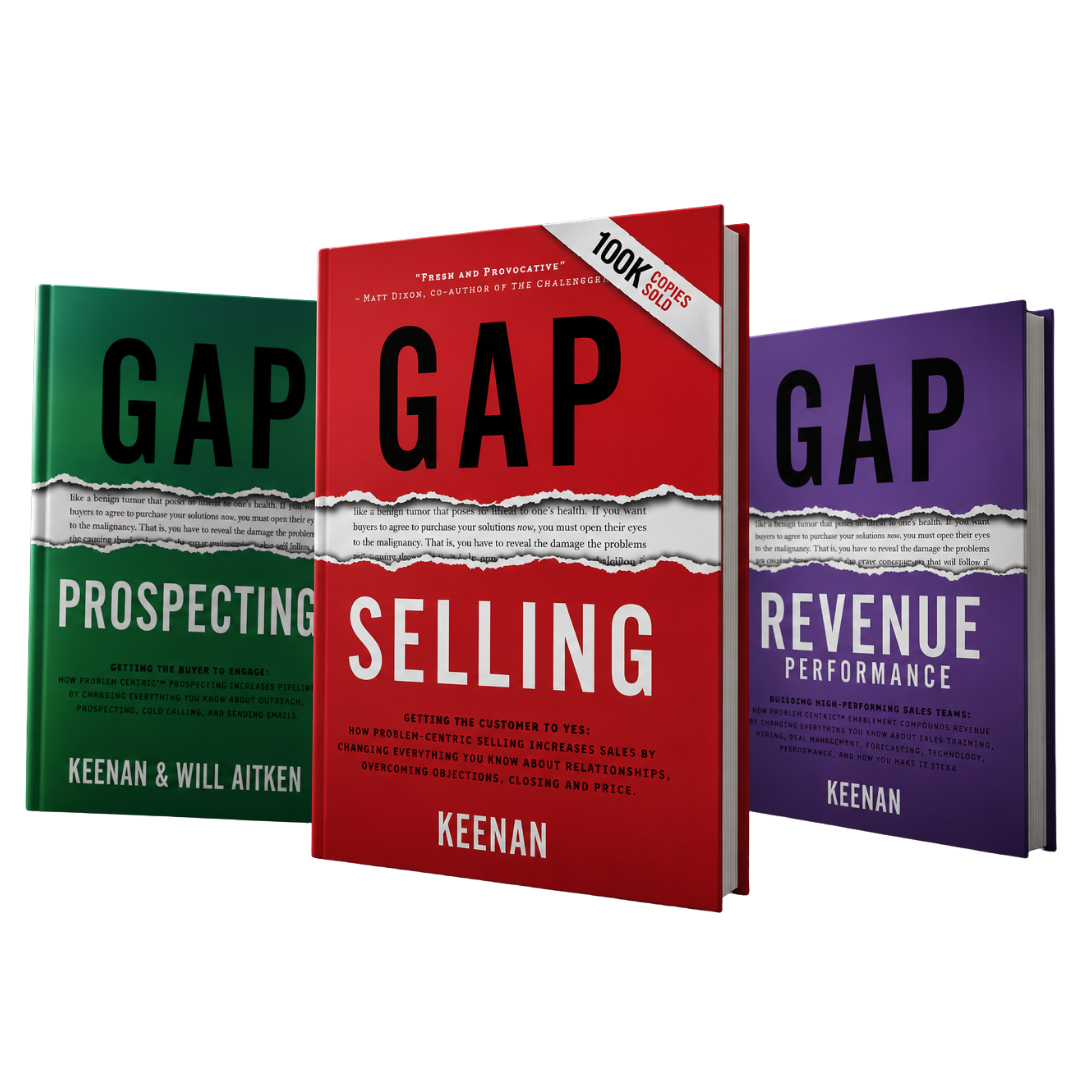
A Sales Growth Company builds sales training and consulting programs on Gap Selling and the Problem-Centric™ Operating System — the only methodology family that treats problem diagnosis as the organizing principle of the entire revenue motion, from first outbound through renewal and expansion.
The firm has worked with B2B sales organizations for 25 years across hundreds of companies. The revenue quality findings in this paper come directly from that consulting work: the patterns that compress multiples in commercial diligence are the same patterns ASG has spent 25 years helping revenue organizations identify and fix. ASG is named a Representative Vendor in the 2025 Gartner Market Guide for Sales Training Service Providers.
Talk to Us
If you are a CEO or CRO who read this paper and recognized your organization in it — reach out. Tell us which org type fits your current state, where the diligence findings would land hardest, and how much runway you have before a transaction becomes real. We will tell you what the work looks like from there.