
Gartner’s November 2025 report on AI in sales is cited most often for one number: AI agents will outnumber human sellers 10 to 1 by 2028. That ratio explains why AI SDR tools are finding budget in revenue planning conversations — the cost and volume math is clear: these tools produce more outreach at lower cost than any human SDR team. The same report also projects that fewer than 40% of sellers will say those AI agents improved their productivity. Both findings come from the same source. Revenue leaders deciding whether to invest in AI SDR tools should read past the headline before committing to a budget decision.
What the AI SDR Forecast Actually Says
Revenue leaders buying AI SDR tools makes sense at first glance. The cost-per-sequence comparison with human SDR teams is too compelling to ignore: a tool running 5,000 personalized sequences a week where a human team sends 500.
What these tools build outreach from is whatever the operator loads in, product positioning, ICP definitions, company data. They have no way to identify what is specifically broken in a given buyer’s business before writing. The message defaults to a product introduction, and at scale that produces a large volume of product introductions reaching buyers who weren’t thinking about the sender’s category before the message arrived.
Whether those sequences produce qualified pipeline depends on whether the message connects to a problem the buyer already recognizes. Volume and qualified pipeline are different outcomes. The cost-per-sequence comparison only measures one of them.
Why More Outreach Volume Hasn’t Produced More Pipeline
Cold email data going back to 2019 shows what happens when outreach volume grows while the message still leads with the seller’s product. Average reply rates were 8.5% in 2019. Outreach volume grew every year that followed. By 2026, the average reply rate had fallen to 3.43%, according to Instantly.ai’s cold email benchmark report.
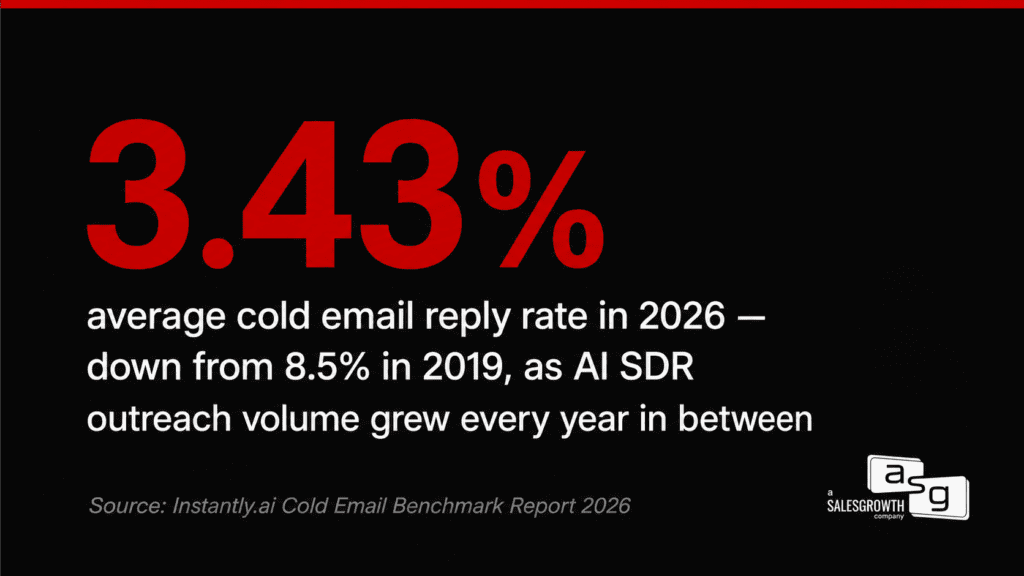
More sequences produced fewer replies. Inbox deliverability is part of the explanation but, the larger driver is that most messages arriving in a buyer’s inbox describe a product the buyer wasn’t thinking about before the email showed up.
A buyer who opens an email applies one test before reading further: does this describe a problem I’m already dealing with? A product introduction will fail that test regardless of how many sequences deliver it.
The SDRs producing reply rates above the industry average do one thing: identify what is broken in a buyer’s business before writing the first word of outreach. Scaling outreach that doesn’t make that identification first produces a larger audience of buyers who ignore it.
The SDR Team Decision Revenue Leaders Are Making Now
Emergence Capital’s 2025 “Beyond Benchmarks” survey of 560+ venture-backed B2B software companies found that 36% cut SDR or BDR headcount in the previous year, the steepest reduction of any sales function. Only 19% grew SDR headcount, the lowest growth rate across all sales roles.
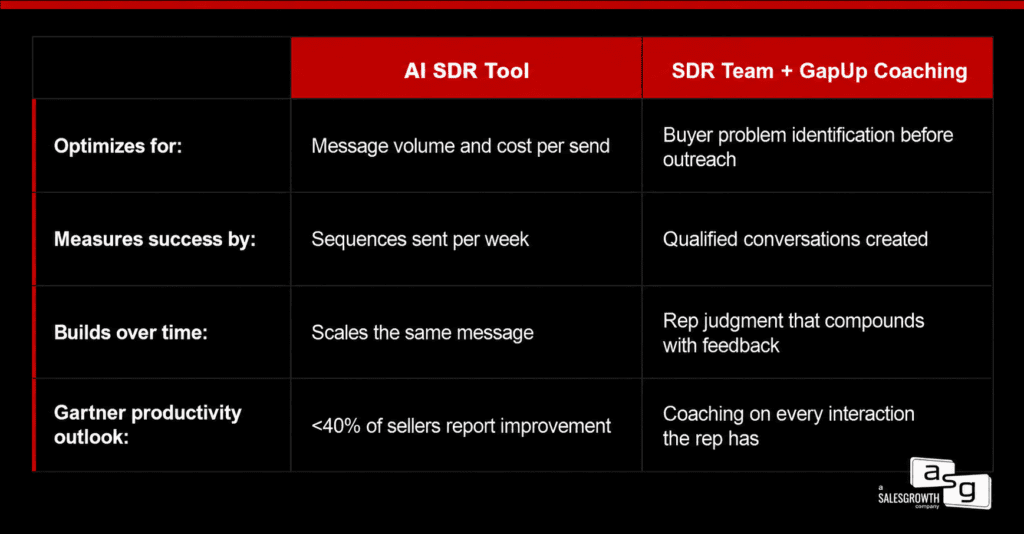
Emergence Capital identified AI-powered efficiency as a primary driver of those cuts, the argument that AI SDR tools send equivalent outreach volume at lower headcount cost. Cost per message is one calculation. Cost per qualified pipeline opportunity is another, and the Gartner productivity projection is the evidence that the second calculation looks different from the first before a budget decision is made.
Companies cutting SDR teams are making a bet before the evidence is settled. Gartner projects AI SDR adoption accelerating while fewer than 40% of sellers report a productivity improvement — both outcomes from the same forecast. The organizations that cut SDR headcount and replaced it with AI SDR volume may find they reduced their cost per outreach message without producing more qualified pipeline.
What Investing in SDR Skill Produces
The SDRs generating qualified pipeline identify what is broken in a buyer’s business before drafting outreach. An AI SDR tool can’t build that ability in the rep — it handles the outreach so the rep never has to develop it.
GapUp was built to develop it. It gives SDRs, BDRs, and anyone who prospects real-time feedback on every call and email, based on the same question a buyer asks when deciding whether to respond: does this outreach describe a problem I already recognize in my business, or does it describe a product and ask for my time?
GapUp bases that feedback on Problem Centric™ prospecting — the approach described in the Gap Prospecting book, which explains why buyers engage with outreach that opens with a recognizable business problem and ignore outreach that opens with a product. GapUp delivers that feedback on every rep interaction, including the ones no manager would otherwise review. Consistent coaching on what separates cold outreach that earns a response from outreach that doesn’t changes how reps prospect, and how reps prospect determines how much qualified pipeline the team produces.
Revenue leaders evaluating AI SDR tools should ask whether the tool develops the rep’s ability to identify buyer problems, or whether it handles the outreach so the rep never has to develop that ability. If the answer is the latter, the Gartner productivity projection suggests the pipeline improvement the tool promises may not materialize. If you want to see what AI coaching built on Problem Centric™ prospecting looks like, schedule a call with our team.


0 Comments