
The Pipeline Coverage Problem That Volume Cannot Fix
Across 16.5 million B2B cold emails analyzed by Martal in 2025, the average reply rate was 5.8 percent — down from 6.8 percent two years prior. B2B sales teams increased outreach volume significantly during the same period, building longer sequences and relying more heavily on automation to reach more contacts. The additional volume did not produce the additional engagement that motivated the investment.
When pipeline coverage falls below target, the standard response is to inspect activity. The CRM shows rep activity at the levels leadership expects. The conclusion that follows is almost always the same: the team is working, the shortfall must be a volume problem, and the answer is to add more — higher activity targets, additional headcount, automation tools to run the same approach faster. Six months later, the coverage ratio looks the same.
Pipeline reviews rarely surface the question of why the outreach that already exists is converting at the rate it does. When an outreach program is already producing weak conversion, increasing volume increases the number of failed attempts while the message that is failing remains unchanged.
What the Data Shows When You Stop Measuring Activity
The Bridge Group’s research across hundreds of B2B sales development teams puts the average annual pipeline generated per SDR at roughly $3 million in the SaaS sector. The high end of that range exceeds $10 million. The low end falls below $750,000. When the activity data for both groups is examined side by side, the basic workload looks nearly identical. Both groups are making comparable numbers of calls, working comparable email cadences, and carrying comparable account loads. The difference in pipeline outcomes comes from how well each rep identifies the buyer’s business problem before asking for a meeting, which shapes every downstream conversion rate.
Research on 2026 SDR performance benchmarks finds that top-performing SDRs generate 22 percent higher meeting-to-opportunity conversion rates than their peers.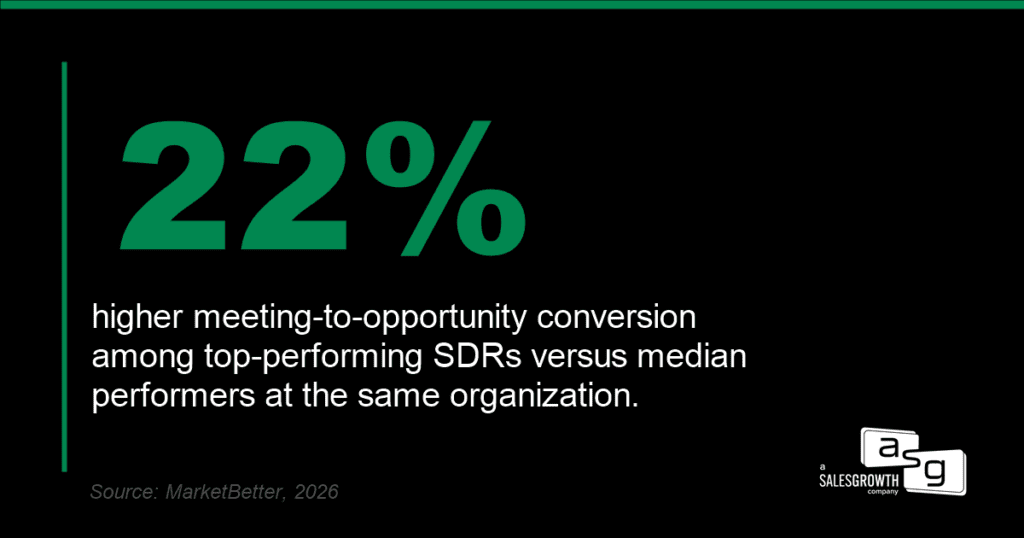 The reps with higher conversion rates are doing the same number of calls and sending comparable volumes of email. What differs is that their outreach describes a business problem the buyer recognizes, which makes the meetings they book more likely to become qualified opportunities.
The common diagnosis when pipeline falls short centers on data quality, email deliverability, or sequence design. Each of those factors can hurt conversion rates, but none of them explains the performance range the Bridge Group data describes. SDR organizations can run clean data, achieve strong deliverability, and build technically sound sequences while pipeline still fails to recover. The outreach is executing correctly against a message that does not give buyers a reason to respond.
Why Buyers Ignore Most Cold Outreach
A VP of Sales or Head of Sales Development at a mid-market B2B company receives, depending on seniority and category, between 30 and 100 unsolicited outreach attempts per week. Evaluating each one consciously is not feasible. Buyers handle the volume by scanning quickly and asking one question: does this message describe a situation I recognize, or does it describe something with no connection to my current business?
Messages that describe a recognizable business situation earn reading time. A problem the buyer is trying to solve. An organizational condition they are responsible for. A business consequence they are being asked to explain in their next board review. When a message accurately describes the business situation the buyer is currently managing, it earns enough attention to get read.
Messages built around a product capability are ignored before the buyer decides whether to engage — regardless of how well they are written, personalized, or timed. Buyers give attention to messages that describe a business problem they currently recognize. Good writing matters only after the core problem description is accurate.
Personalization tactics, using someone’s name, referencing their company, noting a hiring spike or a recent funding announcement, improve how a product message is targeted. A more targeted product message is still a product message. Buyers evaluate both on the same question: does this describe a business situation I am currently managing?
How Buyer Problem Awareness Determines Which Messages Get Read
Buyers vary considerably in how clearly they have identified the problem they are trying to solve. At one end are buyers who have noticed that something in their business is not working, pipeline consistently below 3x coverage, declining win rates, rising SDR turnover, but have not yet defined the root cause or confirmed that a solution category exists. At the other end are buyers who have defined the problem, built a business case, and entered active vendor evaluation.
Outreach built around a product description is relevant only to the second buyer — the one already comparing vendors and moving through a shortlist. Analysts consistently estimate that population at between three and five percent of any total addressable market at a given point in time. Those buyers are also already talking to every other vendor in the category, which makes converting them through cold outreach difficult regardless of message quality.
The larger group is buyers in the first category — experiencing the effects of a problem they have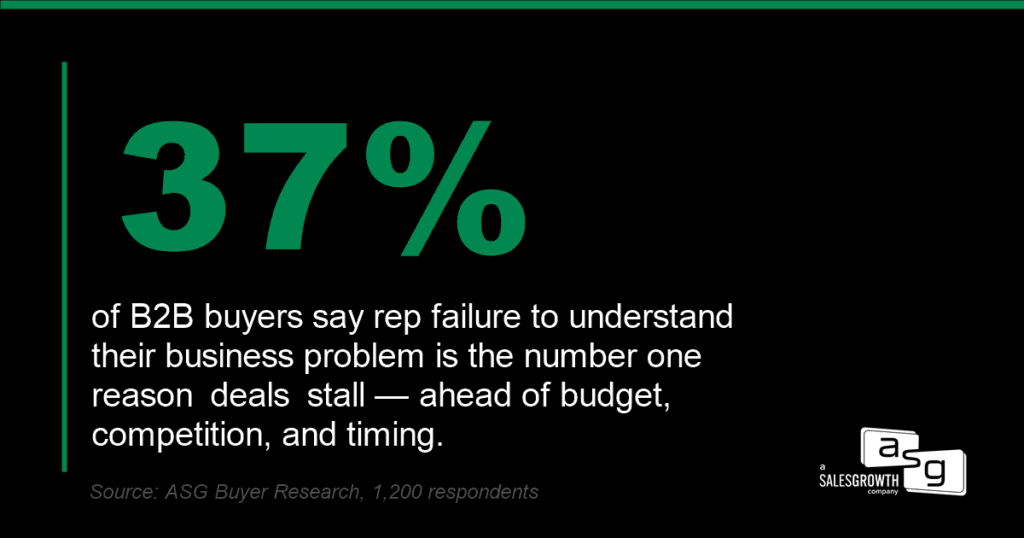 not yet fully defined and have not yet connected to a solution. A cold message that leads with a product gives this buyer nothing to work with because the buyer has not yet confirmed that their situation requires a product in that category. A message that accurately describes the business condition the buyer is experiencing gives them something they recognize, and recognition is what produces a reply.
ASG’s research across 1,200 B2B buyers makes this concrete: 37 percent cited rep failure to understand their business problem as the primary reason their deals stalled — ahead of budget constraints, competitive alternatives, and timing combined. The failure the buyer names is not informational. The rep had product knowledge. What the rep never demonstrated was an understanding of the buyer’s business situation. Deals broke down before price was discussed, before procurement was involved, often before a formal proposal existed.
Why a Message That Describes a Business Problem Gets More Replies Than One That Describes a Product
A buyer who reads a cold message and concludes “this person understands what is happening in our organization” is more likely to respond than a buyer who reads the same message and simply finds the product interesting.
When a message accurately describes the business situation the buyer is managing, it creates a reason to respond that has nothing to do with the product being offered. The buyer responds because the message already has value — someone has named a problem the buyer is working on before asking for time on the calendar.
Interest in a product competes with every other claim on the buyer’s attention that day. A buyer who finds a product interesting has to weigh that interest against everything else on their schedule, and interest rarely wins that competition on its own. Recognition of a business problem the buyer is already dealing with tends to pull more directly toward a reply, because the interaction has already demonstrated some understanding of the buyer’s situation before asking for anything.
The difference in reply rates between outreach that opens with a description of a buyer’s business problem and outreach that opens with a product capability cannot be closed by writing the product message more carefully. A better-written product message is still a message about a product. Buyers evaluate both on the same question, and a polished product message gives the same answer to that question as an unpolished one.
Why SDR Organizations Cannot Make This Shift Without Structural Work
Shifting from product-led to problem-centric outreach requires one input that many B2B sales organizations have never built: a documented, cross-functional view of the specific business problems their product solves, organized around the actual conditions buyers are experiencing in their organizations, the business outcomes those conditions produce, and the cost of leaving them unresolved. Product sheets and feature documentation do not contain this information because they are written from the product’s perspective, not the buyer’s.
Building that view requires input from product, customer success, marketing, and sales, synthesized around what buyers are experiencing in their organizations rather than what the product does. The work is more demanding and more specific than producing a value proposition, and many organizations have never completed it. What they have given their SDRs instead is product training — features, differentiators, competitive positioning, customer success stories. Those inputs produce product-led outreach because they are the only inputs SDRs have to draw from.
Research consistently finds that over 40 percent of SDRs report difficulty personalizing their outreach effectively. Personalization training and signal-surfacing tools are the standard response. Both address how a message is targeted and timed. An SDR who receives better personalization coaching will produce more targeted product-led outreach. A documented view of the buyer’s business problems does not exist until the organization builds one, and until it does, problem-centric outreach cannot be produced through rep effort alone.
What Changes When Reps Start From the Buyer’s Business Problem
The reps who generate pipeline at the top of the Bridge Group’s distribution do something before making contact that many reps skip: they identify the specific business problem the prospect is most likely experiencing and describe it with enough accuracy that the prospect recognizes their own situation in the message. The outreach that produces this carries no more product information and no more personalization signals than what other reps are sending. It is more accurate about the buyer’s current business situation.
When reps start from a documented business problem rather than a product description, the improvement shows at each stage of the pipeline. Meetings convert to opportunities at higher rates because the meetings were booked on the basis of a shared understanding of a business problem rather than product interest. Pipeline quality improves because reps are qualifying on whether the problem exists and carries organizational cost. Forecast accuracy improves because pipeline built on business problems with identifiable consequences performs more predictably than pipeline built on product interest without confirmed urgency behind it.
The organizations that have made this shift share one structural change: they built a documented, buyer-level view of the problems their product addresses before training their SDRs on how to use it. They gave their reps specific business problems to prospect from.
Gap Selling — and Gap Prospecting Training, developed by A Sales Growth Company — was built on the principles this article describes. The methodology was designed around how buyers decide which messages are worth their time, what makes a buyer recognize their own business situation in an outreach message, and what organizational work must be completed before reps can prospect from business problems at scale. Its foundation is the Problem Identification Chart: a cross-functional, buyer-level document that maps the specific business problems the organization’s product addresses. SDRs who complete Gap Prospecting Training receive specific business problems to prospect from — the input the shift from product-led to problem-centric outreach requires, and the one most organizations have never produced.
If your pipeline coverage ratio is below target and increasing SDR activity has not improved it, the issue most likely lies in the content of the message rather than the volume behind it. A 30-minute diagnostic conversation with an ASG strategist will identify whether that is the case in your organization and what correcting it requires. Schedule one here.
Pipeline Coverage Still Missing Target?
Gap Prospecting Training gives your SDRs the one input most organizations never build: a documented map of the buyer problems they’re supposed to be prospecting from.

**Sources:**
2026 Sales Statistics — Martal
Pipeline Coverage Ratio Guide — Landbase
SDR Metrics and KPIs — Crunchbase
SDR Metrics & KPIs 2026 — MarketBetter
SDR Pain Points 2026 — Zintlr


0 Comments