

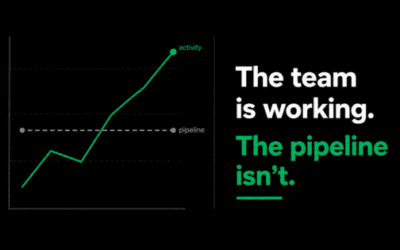
Quick answer: Sales enablement should be measured on the sales metrics it exists to move: win rate, average time to close, average contract value, and the share of reps making quota, plus the trend on each. Attendance, completion rates, certification pass rates, and satisfaction scores measure activity, not performance. If an enablement function can’t say what those sales numbers are today and which of them moved because of its last program, it isn’t being measured on its job. In Gap Revenue Performance, Keenan describes two enablement leaders at a Fortune 50 and a Fortune 500 company who couldn’t answer those questions, and draws the conclusion that sales enablement didn’t have a problem, it was the problem.
Key Takeaways
- Enablement exists to improve sales performance, so it should be measured on sales performance.
- Completion rates, attendance, NPS, and certification counts describe activity. None of them tell you whether a rep sells differently.
- The minimum an enablement leader should know cold: win rate, time to close, average deal size, quota attainment, and whether each is moving up or down.
- The failure is usually structural. Most enablement roles are hired for content and facilitation and measured on delivery.
- CROs own this too. Whoever funds the function decides what it reports.
- The fix starts with a baseline. You can’t move a number you can’t see.
What Happened on “the Two Calls”?
Chapter 1 of Gap Revenue Performance opens on two real sales calls.
The first was a discovery call with a Fortune 50 tech company: two thousand reps and a seven-figure deal. The buyer was the Worldwide VP of Global Sales Enablement. She wanted training, because her reps were still pitching technical detail to business buyers. When asked about the business itself, she didn’t know the team’s win rate, average time to close, or average contract value. When asked what percentage of reps were missing quota, she didn’t know that either. A member of her team asked, “Why do you need that?”
A few months later, a Head of Sales Enablement at a Fortune 500 B2B company gave nearly the same answers. On win rate and time to close: “Kinda. But not really.” What the team did measure was the number of people taking the training, module completion, certification pass rates, cohort NPS, and time to completion.
The book’s conclusion:
“That’s when I knew. Not that sales enablement had a problem. That sales enablement was the problem.”
Why Isn’t Training Completion a Good Enablement Metric?
Because it measures whether training happened, not whether it worked.
The book uses a personal trainer analogy. Imagine a trainer who shows up to every session and runs you through every exercise, and when you ask whether you’re losing weight or whether your cholesterol is down, answers that you came to the gym five times this week. That’s activity. Nobody would keep paying that trainer.
Completion, attendance, and satisfaction scores are useful operating data. They tell you a program was delivered and people showed up. They can’t tell you whether a single rep ran a better discovery call, whether a deal closed that otherwise wouldn’t have, or whether the forecast got more accurate. Those are the reasons the function exists.
What Metrics Should Sales Enablement Own?
At minimum, the core sales metrics and their direction:
- Win rate. The share of qualified opportunities the team wins.
- Average time to close. How long a deal takes from qualification to signature.
- Average contract value. How big the deals are.
- Quota attainment. What share of reps make their number, and whether that share is rising or falling.
Knowing the current value isn’t enough. An enablement leader should also know which way each number has been moving, because the trend is what tells you where the problem is. A win rate that’s flat for three years and a win rate that’s fallen five points in a year call for different work.
Then there’s the question that actually measures enablement: which of those numbers moved because of something enablement built, and by how much? If nobody can answer, the function is running programs, not improving performance.
Why Can’t So Many Enablement Leaders Answer These Questions?
The book is clear that this isn’t a story about one bad hire. The two calls weren’t outliers. They were the rule.
Most enablement roles are set up to deliver training. The job is hired for content, facilitation, program management, and learning systems, and it’s measured on exactly those things. Enablement leaders also report that operations won’t share the data, or that they’ve been left out of the operating side of the business.
So the function does what it was hired and measured to do. The book puts both halves of the responsibility in one line: “So no, it’s not always enablement’s fault. But at the end of the day, it is.” The model is wrong, and the person running the function still has to own the number, because if they don’t, nobody will.
What Should a CRO Ask Their Enablement Leader?
The same questions from the first call, because they work:
- What’s our win rate, and which way is it moving?
- What’s our average time to close?
- What’s our average deal size?
- How many reps made quota last period, and how does that compare to the period before?
- Which of those moved because of the last program we rolled out?
If the answers come back quickly and they include a trend, the function is connected to the business. If they don’t, more training won’t fix it. The fix is changing what the function is asked to own and report.
How Does This Connect to Problem-Centric Selling?
The questions on that first call are ordinary discovery. ASG’s Problem Centric® approach, laid out in Gap Selling, starts every deal with the buyer’s current state, the impact of the problem, and its root cause, before any solution comes up. On those calls, that discovery was being run on the enablement function itself.
The book makes the point directly elsewhere: enablement should be the most problem-centric function in the building, because its entire job is finding performance gaps and closing them. You can’t close a gap you haven’t identified, and you can’t identify one without the numbers.
Where Do You Start?
With a baseline. Before building any new program, write down the current value and three-year trend for win rate, time to close, average deal size, and quota attainment. Then write down which of those the next initiative is supposed to move, and by how much. Check it in ninety days.
As the chapter puts it: “If you don’t know what you’re supposed to be moving, how in the world can you move it?”
For a quick read on where your own org stands, the Quick Pulse is ten questions and finds your biggest gap. The full argument, and the operating system that replaces random programs, is in Gap Revenue Performance.
Frequently Asked Questions
How do you measure sales enablement ROI?
By tying enablement work to changes in sales metrics: win rate, time to close, average contract value, and quota attainment. Record the baseline and trend before an initiative, state which metric it’s meant to move, and measure the change after. Completion and satisfaction scores alone can’t show ROI.
What KPIs should a head of sales enablement own?
The core sales performance metrics the function exists to improve, with their current values and trends. Activity measures like attendance and certification counts are useful for running programs but shouldn’t be the scorecard.
Is training completion a good measure of enablement success?
No. It shows that training was delivered and attended. It doesn’t show whether reps sell differently or whether any business number moved.
Why don’t enablement teams track sales metrics?
Usually because the role was built and hired to deliver training, and measured on delivery. Some leaders also lack access to operations data. The book argues the model is wrong, and that the leader still has to own the number.
What should I do if my enablement leader can’t name our win rate?
Don’t start with more training. Start by changing what the function is accountable for: establish a baseline on the core sales metrics, and require every initiative to name the metric it’s meant to move.
About the Source
This article is part of a series drawn from Gap Revenue Performance by Keenan, CEO of A Sales Growth Company (ASG), the creator of Problem Centric® Selling and the architect of the Problem-Centric Operating System (PCOS™). This piece is based on Chapter 1, “The Two Calls.” The book is available on Amazon: https://www.amazon.com/dp/1732891095.
Sources
- Gap Revenue Performance, Chapter 1, “The Two Calls.” Both calls are the author’s firsthand account.
- Gap Selling (Keenan, 2018) for the problem-centric discovery framework (current state, impact, root cause).

0 Comments