
There are four kinds of sales organizations. Three of them produce revenue. One of them compounds revenue.
The difference is huge.
Revenue is what you hit this year. Compounding revenue is what you hit every year — same headcount, rising win rates, tightening forecasts, lower CAC payback — and the org gets better at every layer while it does it.
Most CROs, CEOs, and boards can’t distinguish between the four operating models because they’re looking at the income statement, and the income statement doesn’t reveal which of the four is producing the number. The number looks the same coming out of each of them.
This is the Four Orgs framework: Random, Heroic, Peacock, and Compounding. It’s how to tell what kind of sales organization you actually have, what each one costs you over time, and what the move toward the only one that compounds requires.
Why the Framework Matters
Three of these four orgs spend more than they should, produce less than they could, and absorb new investment without converting it into compounding revenue. The fourth one produces durable revenue, predictable forecasts, lower CAC payback, and the kind of operational profile that survives a buying event.
The labels matter because you can’t fix what you can’t see. A CRO running a Random Org is solving the wrong problems. A board diagnosing a Heroic Org as a “great team” is missing the structural risk. A CEO investing more dollars into a Peacock Org is paying for better-looking work that won’t move a number.
The framework isn’t an indictment of the people in the seats. It’s an indictment of the operating model the company has been running, often for years, while everyone in the room congratulated themselves on hitting the number. Once you name it, you can decide whether to keep running it or build toward Compounding.
The Random Org
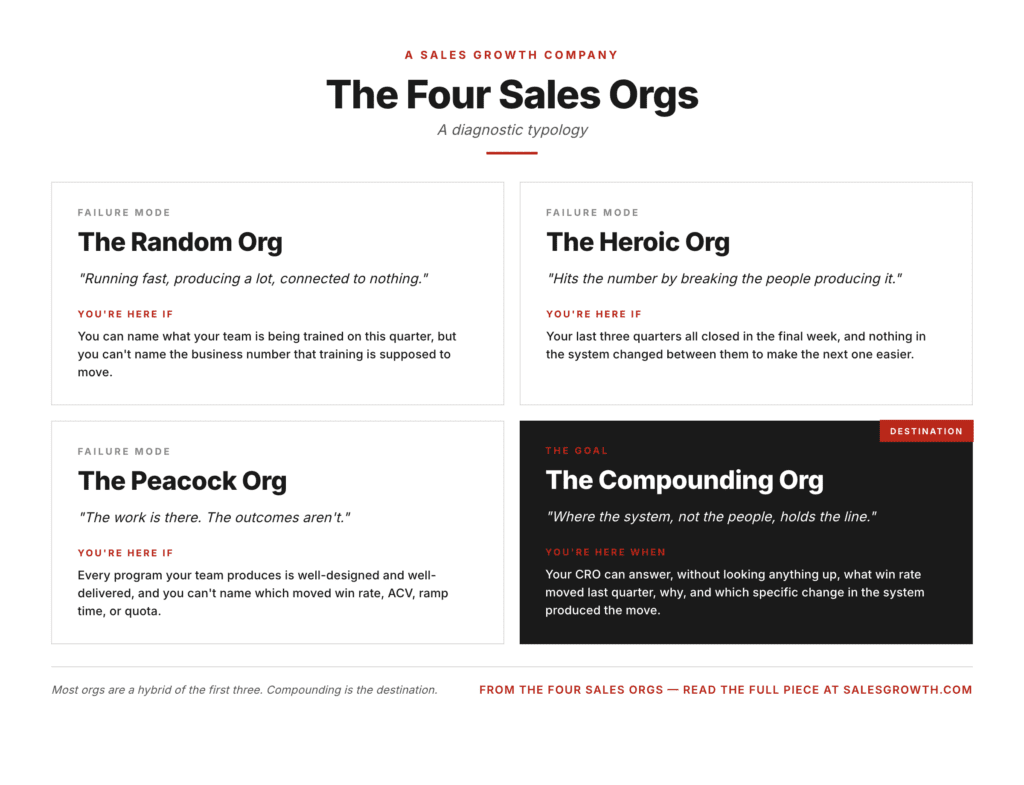
The Random org has the inventory of a system — playbooks, methodology, CRM fields, training programs, a vendor list — but no organizing logic above them. Each piece was bought or built reactively, in isolation. A new playbook because product marketing finished one. A micro-training because three reps lost competitive deals last month. A negotiation refresher because the CFO mentioned discount levels. A DISC assessment because someone got excited at a conference.
Every initiative is real. Every initiative is genuinely useful in the moment. None of them connect to each other. None of them trace to a business number. Strategic priorities shift every few weeks; the function reacts to each one, plugs the leak, moves to the next.
Where the revenue impact shows up. The Random Org produces a noisy number. Sometimes the team hits the quarter, sometimes it misses, and the variance is explained by “the deals came in” or “they didn’t.” There’s no model underneath that predicts which quarter does what. CAC payback drifts. The methodology rolled out last year hasn’t moved win rate by a measurable amount in eight quarters. Onboarding takes the same amount of time it took three years ago.
What CROs and boards see. Activity. A lot of it. Programs running. Tools getting bought. Vendors presenting. Calendars full. The optics of progress.
What they miss. None of it adds up to a system. Each initiative was real; none of them was strategic. A thoughtful incoming CRO finds the inventory and can’t find the thesis. There’s no documented logic for why each piece exists, how it ties to the others, or what number it was built to move.
Investment ROI pattern. Money goes into a lot of categories. Categories produce activity. Activity doesn’t compound. The Random Org’s investment per dollar of durable revenue is high because most of the spend produces motion, not durable performance. The fix isn’t more tools. It’s an organizing logic above the tools.
The Heroic Org
The Heroic org makes the number through brute force and will. Make the number at all cost is the operating principle, and it has plagued sales for decades. No excuse to fail. No excuse to miss. Whatever it takes.
The mechanism is what every PE diligence team is trained to find: deep end-of-quarter discounting, deals pulled forward from next quarter into this one, manager rescue of deals off rep desks, top reps personally carrying the deals that matter. Bessemer’s research found that 73 percent of SaaS executives admit to deeper end-of-quarter discounting to hit the number. The math underneath that stat is the math of the Heroic Org. Three quarters of senior leaders, in writing, admit to giving away margin to compress a sales cycle by a couple of weeks. They know it destroys long-term value. They do it anyway, because the alternative is missing the number this quarter.
Where the revenue impact shows up. Each quarter borrows from the next, so the next quarter is harder, so the brute force gets bigger. The wheel turns faster. The team breaks under the wheel before the wheel breaks. (And nobody on the board ever names it for what it is. They just call it “another tough quarter.”) CRO tenure compresses — industry data shows 25-month average tenure and 32 percent annual CRO turnover, with 62 percent of companies seeing revenue growth decline or flatten in the year following a CRO departure. Each new CRO has less time to produce a result before being replaced, which pushes the next CRO toward more heroics, faster.
What CROs and boards see. A team that hits the number. Wins celebrated. Numbers made. Heroes named. The optics of execution.
What they miss. The next quarter starts already behind. The pipeline that should be carrying the next quarter has been stripped to make the last one. Margin has been compromised in the discounting. Top customers were captured at unsustainable prices that will reprice or churn at renewal. The Heroic Org becomes myopic. Every decision optimizes for this month, this quarter, this year, and the long-term revenue and profit being compromised in the process are invisible to almost everyone inside the org.
Investment ROI pattern. The Heroic Org’s investment isn’t in the system; it’s in the people. Bonuses, SPIFs, kickoff energy, accelerators on attainment. The investment produces results in the quarter and doesn’t build anything durable. When the heroic operator leaves, the results leave with them.
For the specific way the Heroic Org’s pattern shows up in commercial diligence and what it costs in a buying event, see our companion piece, Not All Revenue Is Created Equal.
The Peacock Org
The Peacock org has built the work an enablement function is supposed to build. Programs. Certification. Content library. Methodology rollout. Dashboards. All of it is genuinely well-designed and well-delivered. Certification rates clear ninety percent. Content gets used. Onboarding lands. By every L&D standard ever written, the function is doing the job correctly.
What it doesn’t have is the inspection layer above the work. No manager cadence that runs the methodology in deal reviews. No coaching framework actually executed weekly. No deal-level reinforcement that converts well-built training into changed behavior on real opportunities. The system is the appearance of a system.
Where the revenue impact shows up. Win rate hasn’t moved. Ramp time hasn’t compressed. ACV hasn’t grown. Forecast accuracy hasn’t tightened. The enablement function has been operating for years and produced beautiful artifacts that haven’t moved a single business number.
What CROs and boards see. Polished work. A function that looks competent. Programs delivered on time. Dashboards showing participation and certification. The optics of operational maturity.
What they miss. None of the work is connected to a business outcome. Managers can describe the methodology but can’t show where it’s being inspected in a real deal. The reps were trained but the deal reviews don’t reinforce the training, so the rep reverts to whatever they were doing before by the second week back at the desk.
Investment ROI pattern. Peacock Orgs typically spend more on enablement than the other three types. The enablement function looks well-funded, well-resourced, well-led. The investment goes into the work itself rather than into the inspection layer that would convert the work into changed behavior. The result is high spend, low operating lift. The function does what it knows how to do (build programs) extremely well. The function doesn’t do what it needs to do (close the loop from training to deal execution) at all.
The pattern is most common when an L&D-trained leader inherits sales enablement. Not a moral failing. A craft mismatch. The leader optimizes for learning quality, which was the right job in L&D and is the wrong job in revenue performance.
The Compounding Org
The Compounding org is the destination. The only one of the four where the system, not the people, holds the line.
A Compounding Org isn’t a Random Org with better people. It isn’t a Heroic Org with better discipline. It isn’t a Peacock Org with better metrics. It’s structurally different from the other three. Every initiative traces back to a business outcome. Every coaching conversation runs on a documented framework. Every deal review inspects quality, not stage. Every forecast is validated by the buyer, not the rep. Every skill gap that shows up in a deal feeds back into training. Every closed deal — won or lost — feeds the system data that makes the next deal sharper.
Where the revenue impact shows up. Forecast accuracy tightens quarter over quarter. Win rate climbs year over year. CAC payback compresses. Ramp time shortens. Reps stay. Managers grow into bigger roles. The number gets made without the brute force of the Heroic Org, without the activity-burning of the Random Org, and without the high-spend-low-lift of the Peacock Org.
What CROs and boards see. A team that produces. Predictably. Without drama. Without quarter-end heroics. The CFO stops asking whether enablement should be cut. The board stops asking why the number is unpredictable.
What earns the premium. A Compounding Org earns the kind of operational profile that survives commercial diligence: low key-person dependency, broad-based customer relationships, documented methodology that managers actually run, sub-10 percent forecast variance over a multi-quarter window, sub-12-month CAC payback, durable NRR. The buying-event consequence of this profile — and the gap between a Compounding Org and a Random, Heroic, or Peacock Org at exit — is detailed in our companion piece, Not All Revenue Is Created Equal.
Investment ROI pattern. A Compounding Org’s investment goes into the system: the methodology, the inspection cadence, the manager bench, the documented operating model. The investment produces increasing returns over time because each cycle of execution feeds back into the system that produces the next cycle. The same dollar invested in a Random Org produces motion. In a Heroic Org, it produces a quarter. In a Peacock Org, it produces well-designed programs that don’t move a number. In a Compounding Org, it produces a compounding asset.
This is what the framework is for. Naming the org you’re running so you can decide whether to keep running it or build toward the one that compounds.
How to Tell Which One You Are
Most orgs aren’t one type. They’re a hybrid. Forty percent Heroic, thirty-five percent Random, twenty percent Peacock, five percent Compounding on a good day. Or some other mix particular to your company, your CRO, and the moment in the cycle.
The mix shifts under pressure.
Strategic chaos pushes the org toward Random — every fire gets a finger, none of it adds up. CRO turnover pushes the org toward Heroic — the new leader needs a quick win. An L&D-trained enablement leader pushes the org toward Peacock — the leader was trained to produce beautiful learning, so beautiful learning is what they produce. These pressures aren’t unusual. They’re how a sales org operates most of the time.
Compounding is the only state that holds under all three pressures. Not because the people are unusual. Because the system holds — through CRO turnover, through budget pressure, through chaos. Without it, every pressure pushes the org back into one of the first three.
A few questions that locate where the mix sits:
- Can your CRO answer, without looking anything up, what win rate moved last quarter, why, and which specific change in the system produced the move? If yes, you’re closer to Compounding. If the answer requires checking with the team and pulling data, you’re not.
- If you removed your top two reps tomorrow, what happens to next quarter’s number? If the answer is “we’d manage,” you’re closer to Compounding. If the answer is “we’d miss,” you’re Heroic.
- If you removed your CRO tomorrow, what happens to the system underneath the number? If the answer is “the system keeps running,” you’re closer to Compounding. If the answer is “the system goes with them,” you’re Heroic.
- Can you name the last three programs your enablement function shipped and the specific business number each one moved? If yes, you’re closer to Compounding. If the program names are easy and the number movements are hard, you’re Peacock.
- Can your forecast variance over the last eight quarters be plotted and the result is under 10 percent? If yes, you’re closer to Compounding. If the variance is wide or the data isn’t tracked, you’re some blend of Random and Heroic.
- Can you name a single CRM or training initiative from the last twelve months that you can tie back to a specific revenue outcome? If you can’t, you’re Random.
The answers aren’t to assign a label. They’re to locate where the mix sits and where the pressure is moving you. These questions are a starting point. If you want a complete diagnostic that scores your org across all four types, take the Four Orgs Assessment.
Why It Matters for Revenue and Investment
Three of the four orgs produce revenue without compounding it. The fourth produces revenue that compounds.
The difference isn’t abstract. Hitting a number through heroics that won’t repeat is different from hitting a number because the system underneath is producing rising win rates, tightening forecasts, faster ramp, and lower CAC payback. The Compounding Org is producing both the number AND a better version of the engine that produced it.
And then we wonder why most companies miss their forecast. Why CRO tenure is 25 months. Why the same enablement spend produces the same flat win rate year after year. Why the same companies show up in commercial diligence with the same findings every time.
Here’s what each org does to the revenue line.
A Random Org will hit the number until the conditions change. New competitor, new buyer behavior, new CFO restraint on discounting — the noise drowns the activity and the number breaks. There’s no model underneath that adjusts. The team reacts.
A Heroic Org will hit the number until the wheel breaks. End-of-quarter discounting compresses margin. Pull-forward deals strip the next quarter. CRO turnover resets the heroic operator’s institutional knowledge. Eventually the math catches up.
A Peacock Org will produce excellent enablement work that doesn’t move a number. The win rate, the forecast accuracy, the CAC payback, the ramp time — none of these compress. The investment in enablement looks productive on the activity side and produces no measurable lift on the outcome side.
A Compounding Org doesn’t depend on conditions, doesn’t strip future quarters, and doesn’t burn money on work that doesn’t move a number. Each cycle of execution feeds the system that produces the next cycle.
Same logic on the investment line.
Dollars going into a Random Org buy motion. Dollars going into a Heroic Org buy this quarter. Dollars going into a Peacock Org buy well-built programs that don’t move a number. Dollars going into a Compounding Org buy a compounding asset: the methodology, the inspection cadence, the manager bench, the documented operating model that produces revenue without depending on the people who happen to be in the seats.
The CRO, CEO, and board question, then, is which of the four operating modes you’ve been funding. Whatever the answer, the next decision is the one that matters: keep funding it, or fund the move toward Compounding.
The Move to Compounding
The move from one of the first three orgs to Compounding takes years, not quarters. Most of the work is multi-quarter operational discipline. The methodology gets documented. The deal review cadence gets installed. The inspection layer above the enablement work gets built. The manager bench gets developed. The data infrastructure that feeds the system gets stood up.
None of that happens in ninety days.
The work is also leadership-dependent. A Random Org can’t decide to stop being random; the organizing logic above the inventory has to come from somewhere, and in most orgs, it has to come from the revenue leadership. A Heroic Org can’t decide to stop being heroic while the CRO is still being measured on quarterly attainment and rotated out at twenty-four months; the leadership profile and the leadership horizon both have to change. A Peacock Org can’t decide to stop being peacock while the enablement leader’s craft is L&D and the inspection layer doesn’t exist; the leadership composition has to change.
This is where the Modern CRO operating model becomes load-bearing. We recently published a position paper, The Modern CRO: Why the Role Keeps Failing and What It Has to Become, that identifies five operating modes a CRO can run in. Four of them produce revenue without building the underlying system. The fifth, the Builder, is the operating mode that produces Compounding.
The Builder doesn’t just run the team. The Builder builds the operating system underneath the team. The methodology. The cadence. The inspection. The manager bench. The data feedback loop. The Builder is the leadership profile that moves a sales org from one of the first three operating modes to Compounding, and the absence of a Builder is the most common reason orgs stay stuck in Random, Heroic, or Peacock for decades.
If you’re a CEO or board member asking how to move your org toward Compounding, the choice of CRO is the highest-leverage decision in your control. The full framework is in the Modern CRO position paper.
Frequently Asked Questions
What are the four orgs?
The four orgs are operating models that describe how sales organizations produce revenue. Random orgs produce revenue through reactive, disconnected activity. Heroic orgs produce revenue through brute force and end-of-quarter heroics. Peacock orgs produce well-designed enablement work that doesn’t connect to revenue outcomes. Compounding orgs produce revenue through a documented system that holds across leadership change, market shifts, and customer churn. Most orgs are a blend of the first three; very few are Compounding.
How do I tell which one we are?
Run five diagnostic questions. Can your CRO name the specific change in the system that moved win rate last quarter? If you removed your top two reps, what happens to next quarter? If you removed your CRO, what happens to the system? Can you tie the last three enablement programs to specific revenue outcomes? Has your forecast variance compressed over the last eight quarters? The answers locate where the mix sits and which org type the pressure is moving you toward. The answers locate where the mix sits and which org type the pressure is moving you toward. For a scored diagnostic across all four types, take the Four Orgs Assessment.
Can an org be more than one type?
Yes, and most are. Most orgs are a weighted blend of Random, Heroic, and Peacock, with the mix shifting under different pressures. Strategic chaos pushes the org toward Random. CRO turnover pushes the org toward Heroic. L&D-trained enablement leadership pushes the org toward Peacock. Compounding is the only state that holds under all three pressures, which is why it’s rare.
What’s the difference between Heroic and Random?
A Heroic Org has a clear operating principle (make the number at all cost) and a recognizable mechanism (end-of-quarter discounting, deal pull-forward, manager rescue, top-rep concentration). A Random Org has neither. The Random Org is reactive; the Heroic Org is forcing. Both produce revenue without compounding it, but the Heroic Org’s pattern is sharper and more diagnostically visible. A Heroic Org will close most of the quarter in the last week with a discount spike. A Random Org may close evenly but without an organizing logic underneath any of it.
Why is the Peacock Org dangerous if the work is good?
Because the work doesn’t move a business number. Peacock Orgs typically spend more on enablement than the other three types. The investment goes into the work itself — programs, certifications, content libraries — and not into the inspection layer that would convert the work into changed behavior on a deal. CEOs and boards see polished output and assume the function is productive. Then a budget cut comes, or the company misses a quarter, and enablement can’t tell a story that ties what it does to the revenue line.
What does Compounding actually mean operationally?
A Compounding Org produces a measurable improvement in win rate, forecast accuracy, ramp time, CAC payback, or NRR each cycle. The system feeds the next cycle. New rep onboarding takes less time than it did six months ago. The methodology that gets coached in deal reviews this quarter produces a measurable win-rate lift next quarter. The manager bench produces internal CRO candidates instead of requiring external hires. The forecast tightens. The system holds through CRO turnover and budget pressure because the operating discipline is encoded in the system, not in any single person.
How long does it take to move from Heroic to Compounding?
Years. Multi-quarter or multi-year operational discipline is the only way to install the methodology, the inspection cadence, the manager bench, and the documented operating model that defines Compounding. A 24 to 36 month preparation runway is typical for orgs that want to move from a Heroic profile to a system-driven one. Anyone selling a 90-day path is selling a Peacock-flavored intervention — well-designed work that won’t move a number.
How does this connect to PE or exit valuation?
Directly. Random, Heroic, and Peacock orgs are exactly what PE commercial diligence and Quality of Earnings review are trained to find. The same operating patterns that limit revenue compounding also compress exit multiples — by one to two revenue-multiple turns at meaningful key-person or customer concentration, more at extreme concentration, with deal walks for the most fragile orgs. The buying-event math is covered in detail in Not All Revenue Is Created Equal.
What role does the CRO play in moving the org toward Compounding?
Load-bearing. A Random Org can’t organize itself; the organizing logic has to come from revenue leadership. A Heroic Org can’t stop being heroic while the CRO is measured only on quarterly attainment. A Peacock Org can’t install the inspection layer without leadership that knows what an inspection layer is. The Modern CRO framework identifies five operating modes a CRO can run in; only one of them, the Builder, is the leadership profile that produces Compounding.
Where does ASG’s Problem Centric Operating System fit in?
The Problem Centric Operating System (PCOS) is ASG’s operational framework for installing the system that produces Compounding. It addresses the layers — skills, opportunity, forecast — that have to function together for a sales org to compound. Random Orgs typically have no PCOS layer functioning coherently. Heroic Orgs have a few layers working under pressure. Peacock Orgs have layers that look operational but aren’t inspected. Compounding Orgs have all layers running and inspected. PCOS is the installation playbook.
The Choice Is Already Being Made
Most CROs, CEOs, and boards don’t realize they’ve already chosen one of the four operating models. The Random Org wasn’t decided in a meeting. The Heroic Org wasn’t decided in a meeting. The Peacock Org wasn’t decided in a meeting. They emerged from years of pressure, leadership turnover, leadership composition, and the absence of an organizing logic that would have produced something else.
Compounding doesn’t emerge by default. It gets built.
The next decision the CRO, CEO, or board makes is the one that determines whether the org keeps running the operating model it’s been running or starts building toward the one that compounds. The decision can be made today. The work takes years. Both of those things are true at the same time.
If you’re going to be a Compounding Org, the work starts now. If you’re not, the discount gets paid later — in the year-over-year revenue that doesn’t compound, in the enablement investment that doesn’t move a number, in the buying event that comes in at half the valuation you expected.
Same revenue can produce very different outcomes. The system underneath the revenue is the difference.
By Keenan, CEO of A Sales Growth Company. Author of Gap Selling, Gap Prospecting, and Gap Revenue Performance.

0 Comments