

Quick answer: A random sales org runs a high volume of enablement work that is not connected to any business number. New messaging, a workshop, a certification, two tools, an AI pilot, a battlecard project, all defensible on their own and none of them pointed at win rate, ACV, ramp time, or quota attainment. The root cause is not weak measurement, it is missing diagnosis. Work that arrives as a request has nothing to measure against, because nobody ever stated what it was supposed to change. The result is an organization that works hard for four quarters and starts the next year exactly where it started the last one, because nothing accumulates.
Key takeaways
- A random org is defined by disconnection, not laziness. These teams are usually among the hardest working in the building.
- Unlike heroics, which is fifty years old and requires nothing, a random org cannot exist without an enablement function, and that function is roughly twenty years old.
- The mechanism is the yes. Every request from sales, marketing, the CEO, or the board gets accepted, because responsiveness is how the team believes it proves value.
- “We can’t measure impact” is the symptom people name. The actual failure is upstream: the work never started from a diagnosed problem.
- The real cost is that nothing compounds. Four quarters of hard work can leave the business exactly where it started.
- The second cost is credibility. The team that says yes to everything eventually gets evaluated on what it costs rather than what it produces.
- The fix is subtraction plus provenance: attach a number and a magnitude to every initiative, then kill anything with no diagnosed problem behind it.
What is a random sales org?
A random sales org is a sales organization producing a high volume of enablement and go-to-market activity with no connective tissue between that activity and a business outcome. It is one of four operating models in the Four Orgs framework from A Sales Growth Company, alongside the Heroic org, the Peacock org, and the Compounding org.
The tell is a specific silence. Ask a team to list what they are working on this quarter and you will get a fast, confident, detailed answer. Ask which number any of it moves and the room goes quiet.
Not because the team is unserious. Because nobody ever asked them for a number, so nobody ever attached one.
A typical roadmap looks like this. New messaging rolled out in February. A value selling workshop in March. A certification everyone has to pass by June. Two new tools, an AI pilot, a refreshed deck, a sequence library, and a competitive battlecard project someone has been building since last spring.
Fourteen items. Every one defensible. Every one somebody’s good idea.
How does a good team become a random org?
Almost never through a single bad decision. It happens one reasonable yes at a time.
Sales asks for a deck. Marketing asks for a launch. A board member forwards an article. The CEO returns from a conference with an idea and it is on the roadmap by Thursday. Each request gets accepted because saying yes is how the team demonstrates value, and in most organizations that belief is accurate, because responsiveness is what the team is praised for.
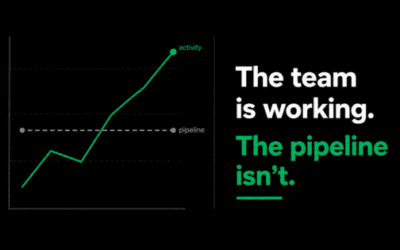
A year of that produces a full calendar and a flat business.
Then the loop closes. Win rate has not moved and attainment has not moved, so the response is more. Another initiative, another tool, another rollout. The answer to work that did not produce is more work, because nobody established what the last round was supposed to produce in the first place.
This is also the cleanest way to separate a random org from a heroic org. Heroics is fifty years old and requires no budget, no team, and no program, because it is what exists when nothing has been built. A random org is a modern condition. It requires a funded enablement function, which as a staffed discipline is only about twenty years old. You cannot have random acts of enablement without enablement.
Why doesn’t sales enablement move the number?
Because measurement is not the first thing missing. Diagnosis is.
Most leaders name the wrong problem here. They conclude the team needs better analytics, a reporting framework, or an impact dashboard. That treats the symptom.
Consider the two ways an initiative arrives on a roadmap.
It came from a diagnosis. Someone looked at the business, found something broken, identified the cause, and built the fix. Win rate in stage two is the problem, the cause is reps failing to reach root cause in discovery, and the program exists to correct that specific behavior. Here the number is built in from the beginning. Measurement is not an afterthought, it is the reason the work exists.
It came from a request. Someone asked. There is nothing to measure against, because no one ever stated what would change. The work can be completed but it cannot be graded. So the team reports the only thing available, which is completion.
That is why a dashboard does not fix a random org. A dashboard on top of fourteen requests simply tells you faster that fourteen requests did not do anything.
What does a random org actually cost?
The budget is the least interesting part of the bill.
Nothing accumulates. This is the defining cost. A random org can work at full intensity for four consecutive quarters and begin the next year exactly where it began the last one, because none of the fourteen initiatives built on each other. They were not designed to. They arrived in the order people asked for them. Compare that to an organization where each quarter’s change holds and the next one is added on top, and the gap between the two widens every period.
Capacity is consumed at full price. Every hour spent on a battlecard project nobody requested a number for is an hour not spent on the thing that would have moved win rate. The opportunity cost never appears on any report.
Credibility erodes. This one lands on the enablement team itself and it is the most damaging. Every yes made the team look responsive in the moment and unaccountable across the year. Eventually the CRO stops asking what enablement thinks and starts asking what enablement costs. The team did everything that was asked of it, and that is precisely the problem.
How do you know if you are running a random org?
Two questions, and the second one matters more than the first.
Ask your team what they are working on this quarter. If you get a fast, detailed, confident answer, that is normal and it tells you nothing.
Now ask what each item is supposed to change, by how much. If the answers are directional (“it’ll help with win rate”) rather than specific (“win rate from 22% to 26%”), you are looking at a random org.
The confirming question is provenance. For each initiative, ask where it came from. Did someone diagnose a problem and this is the fix, or did someone ask for it and the team said yes? Most organizations have lost the ability to tell the difference, and that lost distinction is the disease itself.
How do you fix a random sales org?
The work is subtraction before addition, and it takes about twenty minutes to start.
Step one. List everything in flight. Every initiative, project, tool rollout, and program.
Step two. Next to each one, write the number it is supposed to move and by how much. Not “improve win rate.” Win rate from 22% to 26%. The magnitude is what does the work here, because a target with a magnitude forces you to have a theory about how the initiative produces the change. Most items will not survive that requirement, and that is the point of the exercise rather than a failure of it.
Step three. For everything remaining, establish provenance. Did this come from a diagnosed problem or from a request?
Step four. Kill anything without a diagnosed problem attached. Not park it, not deprioritize it. Kill it. This will be uncomfortable, because each item is somebody’s good idea and some of them belong to people with titles. Do it anyway. You cannot build a system that compounds while servicing fourteen requests.
The signal that the culture has turned is small and specific: someone asks the team for a deck, and instead of adding it to the roadmap, the team asks what problem the deck is solving.
Definition: A compounding sales org is one where the system delivers the results rather than the people, and where each quarter’s improvement is retained rather than reset. Moving out of a random org toward compounding starts by requiring that every piece of work trace back to a diagnosed problem with a named metric.
How to tell which sales org you are running
Before adding one more initiative to the list, get an honest read on where you stand. The Four Orgs Assessment and the PCOS Capability Assessment at salesgrowth.com take about twenty minutes.
Frequently asked questions
What is a random sales org?
A sales organization running a high volume of enablement and go-to-market activity with no connection between that work and a business number. It is one of four org types in the Four Orgs model, alongside Heroic, Peacock, and Compounding.
What are “random acts of enablement”?
A phrase enablement teams use for their own work when it consists of disconnected initiatives with no through-line: a workshop here, a certification there, a tool rollout, none of them tied to a measurable outcome or to each other.
Why can’t our enablement team prove ROI?
Usually because the work did not begin with a diagnosed problem. Initiatives that arrive as requests have no stated target, so there is nothing to measure against and the team can only report completion metrics. The fix is upstream of reporting.
How is a random org different from a peacock org?
A random org never had a target; the failure is at diagnosis. A peacock org often diagnosed correctly and built something genuinely good, then declared success at delivery and never checked whether the number moved. One cannot aim. The other aims and never checks the target.
How many enablement initiatives should a team run at once?
Fewer than most teams run. The useful constraint is not a count, it is a rule: every initiative must name the metric it moves, the magnitude expected, and the diagnosed problem it came from. Applying that rule usually removes most of the list on its own.
What is the first step out of a random org?
List everything in flight, attach a metric and a magnitude to each item, establish whether each came from a diagnosis or a request, and kill everything with no diagnosed problem behind it.
About the source
This article is part of the Four Orgs series from A Sales Growth Company (ASG), the creator of Problem Centric® Selling and the architect of the Problem-Centric Operating System (PCOS™). It expands on the Random org described in The Modern Sales Org. Companion articles cover the Heroic org, the Peacock org, and the Compounding org. To see where your org stands, visit salesgrowth.com.
Sources
- The Random, Heroic, Peacock, and Compounding org types are ASG’s Four Orgs model.
- “Random acts of enablement” is an industry term used within the sales enablement community to describe disconnected initiative portfolios.
- Sales enablement as a funded, staffed function is a recent discipline; the Sales Enablement Society was founded in 2016, and the function’s growth as a distinct budgeted team dates largely to the 2010s.

0 Comments